
Booklet – “Ruth: From Emptiness to Fullness—God’s Sovereign Hand from Moab to Messiah”
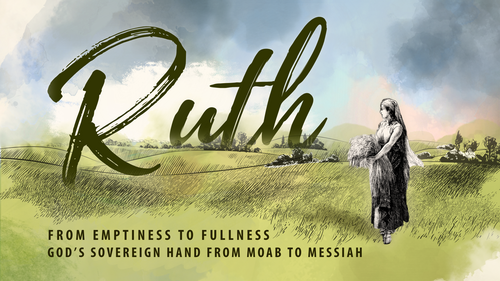
“Ruth: From Emptiness to Fullness—God’s Sovereign Hand from Moab to Messiah”
Table of Contents
Chapter 1 – Sovereign Discipline: “In the Days When the Judges Ruled”
(Ruth 1:1-5)
Chapter 2 – Sovereign Return: “The LORD Had Visited His People”
(Ruth 1:6-22)
Chapter 3 – Sovereign Providence: “She Happened To Come”
(Ruth 2:1-7)
Chapter 4 – Sovereign Grace: “Under Whose Wings You Have Come To Take Refuge”
(Ruth 2:8-23)
Chapter 5 – Sovereign Initiative: “Spread Your Wings Over Your Servant”
(Ruth 3)
Chapter 6 – Sovereign Redemption: “I Cannot Redeem It”
(Ruth 4:1-12)
Chapter 7 – Sovereign Blessing: “The LORD Gave Her Conception”
(Ruth 4:13-22)
Conclusion: From Bethlehem’s Famine To Bethlehem’s Manger
* Note: Booklet content adapted from sermons preached Oct-Nov 2025. Chapter/Sermon 2 preached by Tommy Staggs; chapter/sermon 3 preached by Bob Radank; the rest preached by Scott Wakefield.
(Ruth 1:1-5)
Chapter 2 – Sovereign Return: “The LORD Had Visited His People”
(Ruth 1:6-22)
Chapter 3 – Sovereign Providence: “She Happened To Come”
(Ruth 2:1-7)
Chapter 4 – Sovereign Grace: “Under Whose Wings You Have Come To Take Refuge”
(Ruth 2:8-23)
Chapter 5 – Sovereign Initiative: “Spread Your Wings Over Your Servant”
(Ruth 3)
Chapter 6 – Sovereign Redemption: “I Cannot Redeem It”
(Ruth 4:1-12)
Chapter 7 – Sovereign Blessing: “The LORD Gave Her Conception”
(Ruth 4:13-22)
Conclusion: From Bethlehem’s Famine To Bethlehem’s Manger
* Note: Booklet content adapted from sermons preached Oct-Nov 2025. Chapter/Sermon 2 preached by Tommy Staggs; chapter/sermon 3 preached by Bob Radank; the rest preached by Scott Wakefield.
Introduction: A Small Story With Massive Signficance—From Emptiness To Fullness
The book of Ruth is a small story with massive significance: in four short chapters, a destitute foreign widow with no husband, no land, and no future becomes the great-grandmother of King David and a link in the chain that runs straight to Christ Himself. We move from famine to fullness, death to life, and apparent insignificance to redemptive legacy—all under the quiet yet sovereign hand of God. There are no parting seas here, no fire from heaven, no walls falling at the blast of a trumpet. There is only a widow, a foreigner, a field, and a God who steps onto the stage to act in His own name only twice in the whole book—once to give bread (Ruth 1:6) and once to give a child (Ruth 4:13)—yet whose hand is guiding every detail of the story from the first verse to the last. Though the narrative unfolds during the dark and chaotic days of the judges, it anticipates the reign of David and ultimately the coming of Christ. Ruth reminds us that God is always at work—even in the mundane, painful, and uncertain—to move His people from emptiness to fullness through covenant faithfulness and sovereign grace.
The events of Ruth take place “in the days when the judges ruled,” a time marked by spiritual chaos and moral collapse. The book of Judges ends with the sober verdict that “there was no king in Israel. Everyone did what was right in his own eyes” (Judges 21:25). That is the world Ruth is born into—a world of self-rule, self-trust, and self-destruction. Yet the story quickly zooms in from the national catastrophe to a single struggling family, showing us that even in the thickest national darkness, God is guiding individual lives toward His redemptive purposes. A famine strikes Bethlehem—the “house of bread” no less—prompting Elimelech and Naomi to sojourn in Moab, a land historically hostile to Israel and descended from Lot’s incest with his daughter (Genesis 19:37). There, in that pagan country, Elimelech and both his sons die, leaving Naomi and her Moabite daughters-in-law, Ruth and Orpah, as childless widows. Emptiness piled upon emptiness.
But into that emptiness comes a woman whose loyalty has echoed across three thousand years. Ruth clings to Naomi with profound covenant kindness: “Your people shall be my people, and your God my God” (Ruth 1:16). That bold, faith-filled decision launches the journey from Moab back to Bethlehem and sets the tone for the whole book—commitment, kindness, and redemptive reversal.
Ruth, though a foreigner from pagan Moab, becomes the great biblical model of hesed—steadfast love, covenant kindness, and loyal affection that goes beyond what is owed. Her loving loyalty toward Naomi, her bold initiative to provide as she ventures alone into the harvest fields to glean (Ruth 2:2), and her courageous midnight appeal to Boaz at the threshing floor (Ruth 3:9) make her the pivot point in God’s quiet providential plan. Boaz, the kinsman-redeemer, is portrayed as a man of integrity, kindness, and strength who protects Ruth and redeems Naomi’s family line through marriage. And Naomi—once “pleasant,” who renames herself “bitter” after burying her husband and her sons—is carried by God’s hidden hand from emptiness to fullness, a personal reversal that mirrors the book’s larger gospel message. The story culminates in Boaz redeeming both property and people: he marries Ruth, and they have a son named Obed, who becomes the grandfather of David, the king through whom the Messiah would come.
Four great themes run through this little book like hope-filled threads of theological gold woven through a world of chaos. The first is God’s sovereign providence in ordinary life. There are no obviously supernatural miracles in Ruth—just the quiet, faithful unfolding of God’s plan through everyday, often-boring faithfulness, risky obedience, and kind words. “It happened” that Ruth gleaned in Boaz’s field, but we soon discover that nothing in this story is random. God’s hand is moving every detail toward the birth of Israel’s greatest king, and ultimately toward Jesus, the true Redeemer.
The second theme is kindness and covenant loyalty—hesed. This steadfast love is the glue of Ruth’s relationships. Ruth shows it by staying with Naomi, Boaz shows it by providing protection and food, and God shows it by working behind the scenes to redeem a broken family. The kindness of Boaz and Ruth is no mere niceness; it mirrors God’s own steadfast love for His people.
The third theme is redemption and reversal. The language of redemption is central, appearing more than 20 times across these four chapters. Boaz legally redeems both land and lineage, combining property restoration and levirate marriage in one act of covenant loyalty. That redemption turns Ruth’s and Naomi’s desperate situation into joy, security, and legacy—and it foreshadows the greater redemption Jesus brings, purchasing a people from every nation, including Gentile outsiders like Ruth, into the household of God (Ephesians 2:11-22).
The fourth theme gives the whole book its arc: from Moab to Messiah. Ruth’s journey from a barren widow in a pagan land to the great-grandmother of King David is the heart of the book’s redemptive message. She is a forerunner of the gospel’s promise to bless the nations (Genesis 12:3), and her inclusion in Jesus’ own genealogy (Matthew 1:5) shows that God’s redemptive plan was always bigger than Israel alone. In Ruth, we see in miniature the whole history of salvation: suffering gives way to glory, outsiders become family, and the Messiah’s line is preserved through the faithful acts of ordinary people.
Ruth is also a literary masterpiece—a love story, domestic idyll, and theological narrative all wrapped into one. It begins with famine and death and ends with birth and blessing. Its U-shaped plot, descending into crisis and rising to resolution, reflects the redemptive arc of Scripture itself. Naomi spoke for every empty soul when she said, “I went away full, and the LORD has brought me back empty” (Ruth 1:21), but by the end of the book, she is holding a grandson in her lap, a living sign of the Lord’s kindness and provision. That redemptive, faith-tested journey—from loss to legacy, from emptiness to fullness—is what makes Ruth’s story unforgettable and Christ-centered. In Ruth, we are reminded that no situation is beyond the reach of God’s sovereign kindness and that His plan to send a Redeemer has always included the weak, the foreign, the outcast, and the suffering.
So come and walk these fields. Watch the famine, feel the funerals, and then trace how the God who seems absent turns out to have been present all along—weaving every ordinary thread into a story that runs straight through Bethlehem’s fields to Bethlehem’s manger, and on to an empty tomb.
The events of Ruth take place “in the days when the judges ruled,” a time marked by spiritual chaos and moral collapse. The book of Judges ends with the sober verdict that “there was no king in Israel. Everyone did what was right in his own eyes” (Judges 21:25). That is the world Ruth is born into—a world of self-rule, self-trust, and self-destruction. Yet the story quickly zooms in from the national catastrophe to a single struggling family, showing us that even in the thickest national darkness, God is guiding individual lives toward His redemptive purposes. A famine strikes Bethlehem—the “house of bread” no less—prompting Elimelech and Naomi to sojourn in Moab, a land historically hostile to Israel and descended from Lot’s incest with his daughter (Genesis 19:37). There, in that pagan country, Elimelech and both his sons die, leaving Naomi and her Moabite daughters-in-law, Ruth and Orpah, as childless widows. Emptiness piled upon emptiness.
But into that emptiness comes a woman whose loyalty has echoed across three thousand years. Ruth clings to Naomi with profound covenant kindness: “Your people shall be my people, and your God my God” (Ruth 1:16). That bold, faith-filled decision launches the journey from Moab back to Bethlehem and sets the tone for the whole book—commitment, kindness, and redemptive reversal.
Ruth, though a foreigner from pagan Moab, becomes the great biblical model of hesed—steadfast love, covenant kindness, and loyal affection that goes beyond what is owed. Her loving loyalty toward Naomi, her bold initiative to provide as she ventures alone into the harvest fields to glean (Ruth 2:2), and her courageous midnight appeal to Boaz at the threshing floor (Ruth 3:9) make her the pivot point in God’s quiet providential plan. Boaz, the kinsman-redeemer, is portrayed as a man of integrity, kindness, and strength who protects Ruth and redeems Naomi’s family line through marriage. And Naomi—once “pleasant,” who renames herself “bitter” after burying her husband and her sons—is carried by God’s hidden hand from emptiness to fullness, a personal reversal that mirrors the book’s larger gospel message. The story culminates in Boaz redeeming both property and people: he marries Ruth, and they have a son named Obed, who becomes the grandfather of David, the king through whom the Messiah would come.
Four great themes run through this little book like hope-filled threads of theological gold woven through a world of chaos. The first is God’s sovereign providence in ordinary life. There are no obviously supernatural miracles in Ruth—just the quiet, faithful unfolding of God’s plan through everyday, often-boring faithfulness, risky obedience, and kind words. “It happened” that Ruth gleaned in Boaz’s field, but we soon discover that nothing in this story is random. God’s hand is moving every detail toward the birth of Israel’s greatest king, and ultimately toward Jesus, the true Redeemer.
The second theme is kindness and covenant loyalty—hesed. This steadfast love is the glue of Ruth’s relationships. Ruth shows it by staying with Naomi, Boaz shows it by providing protection and food, and God shows it by working behind the scenes to redeem a broken family. The kindness of Boaz and Ruth is no mere niceness; it mirrors God’s own steadfast love for His people.
The third theme is redemption and reversal. The language of redemption is central, appearing more than 20 times across these four chapters. Boaz legally redeems both land and lineage, combining property restoration and levirate marriage in one act of covenant loyalty. That redemption turns Ruth’s and Naomi’s desperate situation into joy, security, and legacy—and it foreshadows the greater redemption Jesus brings, purchasing a people from every nation, including Gentile outsiders like Ruth, into the household of God (Ephesians 2:11-22).
The fourth theme gives the whole book its arc: from Moab to Messiah. Ruth’s journey from a barren widow in a pagan land to the great-grandmother of King David is the heart of the book’s redemptive message. She is a forerunner of the gospel’s promise to bless the nations (Genesis 12:3), and her inclusion in Jesus’ own genealogy (Matthew 1:5) shows that God’s redemptive plan was always bigger than Israel alone. In Ruth, we see in miniature the whole history of salvation: suffering gives way to glory, outsiders become family, and the Messiah’s line is preserved through the faithful acts of ordinary people.
Ruth is also a literary masterpiece—a love story, domestic idyll, and theological narrative all wrapped into one. It begins with famine and death and ends with birth and blessing. Its U-shaped plot, descending into crisis and rising to resolution, reflects the redemptive arc of Scripture itself. Naomi spoke for every empty soul when she said, “I went away full, and the LORD has brought me back empty” (Ruth 1:21), but by the end of the book, she is holding a grandson in her lap, a living sign of the Lord’s kindness and provision. That redemptive, faith-tested journey—from loss to legacy, from emptiness to fullness—is what makes Ruth’s story unforgettable and Christ-centered. In Ruth, we are reminded that no situation is beyond the reach of God’s sovereign kindness and that His plan to send a Redeemer has always included the weak, the foreign, the outcast, and the suffering.
So come and walk these fields. Watch the famine, feel the funerals, and then trace how the God who seems absent turns out to have been present all along—weaving every ordinary thread into a story that runs straight through Bethlehem’s fields to Bethlehem’s manger, and on to an empty tomb.
Chapter 1 — Sovereign Discipline: “In the Days When The Judges Ruled” (Ruth 1:1-5)
Have you ever noticed how the world is always taken aback when things go wrong, as if it should somehow be a surprise that we live in a broken world of thorns and thistles? For the world without God, it is always a shock when the wells run dry, the crops fail, and the plans come up empty. So when the very first verse of Ruth says there was “a famine in the land,” the natural human response is to scramble for a quick fix, as though the famine itself were the deepest problem.
But famine is never the main story. It is a symptom—a warning light on the dashboard signaling that something far deeper has gone wrong. Here in Ruth, it is a signal that Israel’s spiritual engine has locked up. And so the book opens by quietly summoning us to recognize God’s sovereign hand even in times of decline.
⎯⎯⎯⎯⎯⎯⎯⎯⎯⎯
Recognize God’s Hand In Times Of Decline (Ruth 1:1a)
1 In the days when the judges ruled there was a famine in the land.
Verse 1 begins with a theological diagnosis: “In the days when the judges ruled.” That single phrase sets the entire mood. It names a season of national decline and spiritual chaos, the very era the previous book describes with the chilling words, “everyone did what was right in his own eyes” (Judges 21:25). Godlessness ruled the day. And the Hebrew sharpens the point: the phrase reads literally “in the days of the judging of the judges,” a construction that frames not a single moment but a whole, ongoing era—and the word translated “judges” is itself a participle, “the ones ruling,” marking this as a settled, durative condition. The rulers were technically ruling, and yet no one was truly being ruled at all.
So it should come as no surprise that “there was a famine in the land” (v. 1). Famine was precisely one of the covenant consequences about which God had warned His people. Deuteronomy 28 promised that if Israel turned from the Lord, the heavens would become bronze and the earth iron, hardened and closed, yielding no rain and no harvest. Yet this famine was not punishment alone; it was God using hard circumstances to redirect His people’s attention, withholding rain to awaken repentance and turn His people back to Himself.
That is the crucial point. In Scripture again and again, a famine like this is not the mark of God’s absence but of His intervention. He is not neglecting His people; He is confronting them. As a good father disciplines a child to bring him back to safety, so God uses famine to call Israel back to covenant loyalty. “The Lord disciplines the one he loves” (Hebrews 12:6). What looks like abandonment is actually the warning light of a love that refuses to let His people starve their souls in peace.
⎯⎯⎯⎯⎯⎯⎯⎯⎯⎯
The Peril Of Seeking Security Outside The Covenant Land (Ruth 1:1b-2)
1 …and a man of Bethlehem in Judah went to sojourn in the country of Moab, he and his wife and his two sons. 2 The name of the man was Elimelech and the name of his wife Naomi, and the names of his two sons were Mahlon and Chilion. They were Ephrathites from Bethlehem in Judah. They went into the country of Moab and remained there.
The text continues with a detail placed there on purpose: “a man of Bethlehem in Judah went to sojourn in the country of Moab” (v. 1). Bethlehem means “house of bread” or “house of food.” So during a famine, a man from the house of bread leaves the place of plenty—where God’s ultimate promise would one day be fulfilled—to find crumbs in pagan Moab, as enemy a Gentile territory as existed. We are told nothing about whether Moab even had food; only that he left God’s covenant land to look for life among God’s enemies.
The names sharpen the irony. Elimelech means “My God is King,” yet he seeks help outside his King’s promised land, acting like a man whose god is financial security. Naomi means “pleasant,” though she will rename herself “bitter” before the chapter ends. And the sons, Mahlon and Chilion, bear names meaning “sickly” and “wasting away”—names that make grim sense for boys born during famine and that stand over the story like a pair of foreshadowing tombstones. The family were Ephrathites, which is the text’s way of telling us they came from a well-established and respected clan. This was not a marginal family fleeing in raw desperation but a well-rooted covenant household abandoning the land of promise. They knew better.
Watch the geography turn into theology. The little section begins with Elimelech going “to sojourn” (v. 1), a word meaning to dwell temporarily. It ends with the family having “remained there” (v. 2). Elimelech intended a short stay—just until things improved—but the compromises with the world that promise to be small and temporary are always quietly rooting themselves into permanence. There is a sinister echo in that word “remained.” It is the same posture that marked Babel, where men “settled there” in open defiance of God’s command to fill the earth (Genesis 11:2)—and it is the exact opposite of Abram, who was told to “Go from your country” to the land God would show him (Genesis 12:1), and of the church, sent out to “go therefore and make disciples of all nations” (Matthew 28:19). The danger is not settling as such, for God Himself would later command Israel to settle Canaan; the danger is settling where God never sent you. Elimelech left the land of promise to find life among the enemies of God’s people, a people whom Deuteronomy 23:3-6 had barred from the assembly “even to the tenth generation.” This is the danger of a pragmatic faith that abandons obedience the moment it stops seeming to “work.” Isaiah 31:1 is a warning: “Woe to those who go down to Egypt for help… but do not look to the Lord.” Elimelech’s journey is not just geographical; it is theological. He is trading trust in God’s promises for self-reliance, as if leaving a fortified city during a siege to forage among the enemy’s tents. For a moment, it feels clever—you find a scrap of bread—but you have stepped outside the wall of protection, and sooner or later, the enemy notices.
⎯⎯⎯⎯⎯⎯⎯⎯⎯⎯
The Bitter Consequences Of Disobedience (Ruth 1:3-5)
3 But Elimelech, the husband of Naomi, died, and she was left with her two sons. 4 These took Moabite wives; the name of the one was Orpah and the name of the other Ruth. They lived there about ten years, 5 and both Mahlon and Chilion died, so that the woman was left without her two sons and her husband.
Verse 3 begins the unraveling, and the grammar is blunt: “But Elimelech, the husband of Naomi, died.” No reason is given. Just the fact, and the fallout: “she was left with her two sons” (v. 3). Naomi is now a vulnerable widow in a foreign land. And the sons follow their father’s footsteps of compromise—“These took Moabite wives” (v. 4)—stepping outside God’s covenant design for marriage in direct violation of Deuteronomy 7:3-4, where the Lord had said of the surrounding nations, “You shall not intermarry with them… for they would turn away your sons from following me, to serve other gods.” The phrase “they lived there about ten years” (v. 4) marks the third stage in the slide from sojourning to remaining to settling.
Then verse 5 drives the knife all the way in: “both Mahlon and Chilion died, so that the woman was left without her two sons and her husband.” Trace the descent: in verse 1, it is Elimelech with his wife and two sons; in verse 3, it is Naomi with her two sons; in verse 5, it is one woman, left without sons or a husband—three graves on foreign soil. The Hebrew phrase rendered “she was left” conveys the sense of bereavement, echoing the covenant curses of Deuteronomy 32:25. Naomi’s name—“pleasant”—now rings hollow. The line of Elimelech has evaporated into Moabite dust. He left the land of promise to secure life, and instead, he buried his family. That is what sin always does: it promises life and delivers death (Romans 6:23).
And yet even here, in judgment, God’s hidden mercy is germinating. While the author slows the story to let us feel the emptiness that will one day be filled, Naomi’s loss is not random punishment but severe mercy—the painful plow turning the ground for future fruit. When your world collapses, it may not be God’s anger but His alignment of your heart with His holiness, for even in judgment He is preparing a harvest of grace that will ripen in Christ.
So let three truths simmer in your life. First, God’s discipline is never random or capricious but always purposeful—just as Israel’s famine in verse 1 was no accident but a summons. Your trials may likewise be designed to turn your heart back to Him; the pain that feels punitive in the short term may prove protective in the long term. When the drought hits, the better question is not “Why me?” but “What is God forming in me?” He is not withholding bread to starve you; He is weaning you off empty idols so you will learn to crave the Bread of Life. Second, seeking security apart from God always ends in barrenness, as Elimelech learned when he traded the house of bread for the fields of Moab and harvested three graves. Every refuge apart from God eventually becomes a desert. “There is a way that seems right to a man, but its end is the way to death” (Proverbs 14:12). The fields of Moab are still open for business all around us, promising easier harvests they never deliver—the career that trumps calling, the compromise that buys temporary peace, the relationship that feels easier than obedience. When Jesus told us to “abide” in Him (John 15:4), it was because He knows we wither apart from the Vine. Third, God’s redemptive purposes are at work even in judgment. Naomi’s losses are real and bitter, yet through them God will weave Ruth into the messianic line. “For those who love God all things work together for good” (Romans 8:28). Naomi’s sorrow sets up Ruth’s loyalty; Ruth’s loyalty leads to Boaz’s love; Boaz and Ruth produce Obed; and Obed brings David, whose greater Son will reign forever. If the book of Ruth begins in famine, it ends in fullness—and the same Bethlehem that starves in verse 1 will one day cradle the Bread of Life Himself.
So perhaps today you feel like Naomi—emptied, disciplined, uncertain. Take heart: the famine is not forever. The God who rules the judges still rules the drought. He uses famine to make us hungry for grace and loss to make us long for the Redeemer who never leaves us without hope. Like the prodigal in Luke 15, let your famine become the grace that drives you home to your Father.
Where are you tempted to seek security apart from God’s covenant promises, and how will you instead entrust your emptiness to His redemptive purposes you cannot yet see?
But famine is never the main story. It is a symptom—a warning light on the dashboard signaling that something far deeper has gone wrong. Here in Ruth, it is a signal that Israel’s spiritual engine has locked up. And so the book opens by quietly summoning us to recognize God’s sovereign hand even in times of decline.
⎯⎯⎯⎯⎯⎯⎯⎯⎯⎯
Recognize God’s Hand In Times Of Decline (Ruth 1:1a)
1 In the days when the judges ruled there was a famine in the land.
Verse 1 begins with a theological diagnosis: “In the days when the judges ruled.” That single phrase sets the entire mood. It names a season of national decline and spiritual chaos, the very era the previous book describes with the chilling words, “everyone did what was right in his own eyes” (Judges 21:25). Godlessness ruled the day. And the Hebrew sharpens the point: the phrase reads literally “in the days of the judging of the judges,” a construction that frames not a single moment but a whole, ongoing era—and the word translated “judges” is itself a participle, “the ones ruling,” marking this as a settled, durative condition. The rulers were technically ruling, and yet no one was truly being ruled at all.
So it should come as no surprise that “there was a famine in the land” (v. 1). Famine was precisely one of the covenant consequences about which God had warned His people. Deuteronomy 28 promised that if Israel turned from the Lord, the heavens would become bronze and the earth iron, hardened and closed, yielding no rain and no harvest. Yet this famine was not punishment alone; it was God using hard circumstances to redirect His people’s attention, withholding rain to awaken repentance and turn His people back to Himself.
That is the crucial point. In Scripture again and again, a famine like this is not the mark of God’s absence but of His intervention. He is not neglecting His people; He is confronting them. As a good father disciplines a child to bring him back to safety, so God uses famine to call Israel back to covenant loyalty. “The Lord disciplines the one he loves” (Hebrews 12:6). What looks like abandonment is actually the warning light of a love that refuses to let His people starve their souls in peace.
⎯⎯⎯⎯⎯⎯⎯⎯⎯⎯
The Peril Of Seeking Security Outside The Covenant Land (Ruth 1:1b-2)
1 …and a man of Bethlehem in Judah went to sojourn in the country of Moab, he and his wife and his two sons. 2 The name of the man was Elimelech and the name of his wife Naomi, and the names of his two sons were Mahlon and Chilion. They were Ephrathites from Bethlehem in Judah. They went into the country of Moab and remained there.
The text continues with a detail placed there on purpose: “a man of Bethlehem in Judah went to sojourn in the country of Moab” (v. 1). Bethlehem means “house of bread” or “house of food.” So during a famine, a man from the house of bread leaves the place of plenty—where God’s ultimate promise would one day be fulfilled—to find crumbs in pagan Moab, as enemy a Gentile territory as existed. We are told nothing about whether Moab even had food; only that he left God’s covenant land to look for life among God’s enemies.
The names sharpen the irony. Elimelech means “My God is King,” yet he seeks help outside his King’s promised land, acting like a man whose god is financial security. Naomi means “pleasant,” though she will rename herself “bitter” before the chapter ends. And the sons, Mahlon and Chilion, bear names meaning “sickly” and “wasting away”—names that make grim sense for boys born during famine and that stand over the story like a pair of foreshadowing tombstones. The family were Ephrathites, which is the text’s way of telling us they came from a well-established and respected clan. This was not a marginal family fleeing in raw desperation but a well-rooted covenant household abandoning the land of promise. They knew better.
Watch the geography turn into theology. The little section begins with Elimelech going “to sojourn” (v. 1), a word meaning to dwell temporarily. It ends with the family having “remained there” (v. 2). Elimelech intended a short stay—just until things improved—but the compromises with the world that promise to be small and temporary are always quietly rooting themselves into permanence. There is a sinister echo in that word “remained.” It is the same posture that marked Babel, where men “settled there” in open defiance of God’s command to fill the earth (Genesis 11:2)—and it is the exact opposite of Abram, who was told to “Go from your country” to the land God would show him (Genesis 12:1), and of the church, sent out to “go therefore and make disciples of all nations” (Matthew 28:19). The danger is not settling as such, for God Himself would later command Israel to settle Canaan; the danger is settling where God never sent you. Elimelech left the land of promise to find life among the enemies of God’s people, a people whom Deuteronomy 23:3-6 had barred from the assembly “even to the tenth generation.” This is the danger of a pragmatic faith that abandons obedience the moment it stops seeming to “work.” Isaiah 31:1 is a warning: “Woe to those who go down to Egypt for help… but do not look to the Lord.” Elimelech’s journey is not just geographical; it is theological. He is trading trust in God’s promises for self-reliance, as if leaving a fortified city during a siege to forage among the enemy’s tents. For a moment, it feels clever—you find a scrap of bread—but you have stepped outside the wall of protection, and sooner or later, the enemy notices.
⎯⎯⎯⎯⎯⎯⎯⎯⎯⎯
The Bitter Consequences Of Disobedience (Ruth 1:3-5)
3 But Elimelech, the husband of Naomi, died, and she was left with her two sons. 4 These took Moabite wives; the name of the one was Orpah and the name of the other Ruth. They lived there about ten years, 5 and both Mahlon and Chilion died, so that the woman was left without her two sons and her husband.
Verse 3 begins the unraveling, and the grammar is blunt: “But Elimelech, the husband of Naomi, died.” No reason is given. Just the fact, and the fallout: “she was left with her two sons” (v. 3). Naomi is now a vulnerable widow in a foreign land. And the sons follow their father’s footsteps of compromise—“These took Moabite wives” (v. 4)—stepping outside God’s covenant design for marriage in direct violation of Deuteronomy 7:3-4, where the Lord had said of the surrounding nations, “You shall not intermarry with them… for they would turn away your sons from following me, to serve other gods.” The phrase “they lived there about ten years” (v. 4) marks the third stage in the slide from sojourning to remaining to settling.
Then verse 5 drives the knife all the way in: “both Mahlon and Chilion died, so that the woman was left without her two sons and her husband.” Trace the descent: in verse 1, it is Elimelech with his wife and two sons; in verse 3, it is Naomi with her two sons; in verse 5, it is one woman, left without sons or a husband—three graves on foreign soil. The Hebrew phrase rendered “she was left” conveys the sense of bereavement, echoing the covenant curses of Deuteronomy 32:25. Naomi’s name—“pleasant”—now rings hollow. The line of Elimelech has evaporated into Moabite dust. He left the land of promise to secure life, and instead, he buried his family. That is what sin always does: it promises life and delivers death (Romans 6:23).
And yet even here, in judgment, God’s hidden mercy is germinating. While the author slows the story to let us feel the emptiness that will one day be filled, Naomi’s loss is not random punishment but severe mercy—the painful plow turning the ground for future fruit. When your world collapses, it may not be God’s anger but His alignment of your heart with His holiness, for even in judgment He is preparing a harvest of grace that will ripen in Christ.
So let three truths simmer in your life. First, God’s discipline is never random or capricious but always purposeful—just as Israel’s famine in verse 1 was no accident but a summons. Your trials may likewise be designed to turn your heart back to Him; the pain that feels punitive in the short term may prove protective in the long term. When the drought hits, the better question is not “Why me?” but “What is God forming in me?” He is not withholding bread to starve you; He is weaning you off empty idols so you will learn to crave the Bread of Life. Second, seeking security apart from God always ends in barrenness, as Elimelech learned when he traded the house of bread for the fields of Moab and harvested three graves. Every refuge apart from God eventually becomes a desert. “There is a way that seems right to a man, but its end is the way to death” (Proverbs 14:12). The fields of Moab are still open for business all around us, promising easier harvests they never deliver—the career that trumps calling, the compromise that buys temporary peace, the relationship that feels easier than obedience. When Jesus told us to “abide” in Him (John 15:4), it was because He knows we wither apart from the Vine. Third, God’s redemptive purposes are at work even in judgment. Naomi’s losses are real and bitter, yet through them God will weave Ruth into the messianic line. “For those who love God all things work together for good” (Romans 8:28). Naomi’s sorrow sets up Ruth’s loyalty; Ruth’s loyalty leads to Boaz’s love; Boaz and Ruth produce Obed; and Obed brings David, whose greater Son will reign forever. If the book of Ruth begins in famine, it ends in fullness—and the same Bethlehem that starves in verse 1 will one day cradle the Bread of Life Himself.
So perhaps today you feel like Naomi—emptied, disciplined, uncertain. Take heart: the famine is not forever. The God who rules the judges still rules the drought. He uses famine to make us hungry for grace and loss to make us long for the Redeemer who never leaves us without hope. Like the prodigal in Luke 15, let your famine become the grace that drives you home to your Father.
Where are you tempted to seek security apart from God’s covenant promises, and how will you instead entrust your emptiness to His redemptive purposes you cannot yet see?
Chapter 2 — Sovereign Return: “The LORD Had Visited His People” (Ruth 1:6-22)
On some level, we all know what it feels like to be empty. It may not look like famine, but it feels like it—dry, heavy, endless. For some, it is exhaustion; for others, loneliness or regret; for still others, the slow weight of trying to hold life together while it slips through their fingers. Sometimes our own sin takes us there, and sometimes it is simply the brokenness of a fallen world. We all have our Moabs—those places we run to when life feels unbearable, the things we hope will give relief but cannot. And no matter how we got there, emptiness makes us long for home. That is exactly where Naomi’s story picks up, and that is where so many of ours do, too.
⎯⎯⎯⎯⎯⎯⎯⎯⎯⎯
Grace Goes Ahead Of Us (Ruth 1:6-7)
6 Then she arose with her daughters-in-law to return from the country of Moab, for she had heard in the fields of Moab that the LORD had visited his people and given them food. 7 So she set out from the place where she was with her two daughters-in-law, and they went on the way to return to the land of Judah.
The passage opens with God’s quiet provision: Naomi “had heard in the fields of Moab that the LORD had visited his people and given them food” (v. 6). That single sentence sets the trajectory for much of what follows. The word “visited” does not mean God merely stopped by. It is a covenant word. When God “visited his people” in Exodus 4:31, He saw their affliction in Egypt and came down to deliver them. The word carries the weight of God’s gracious, merciful action breaking into history. And the food He gives is literally “bread”—a deliberate wordplay with Bethlehem, the house of bread. The famine that drove Naomi’s family away has been reversed; God has refilled the house of bread.
So the whole story now bends back toward Bethlehem. It is a “return” (vv. 6-7). And that little word matters more than it first appears, for the Hebrew verb meaning “to turn back, to return” rings out twelve times across this single chapter. It is the thread that ties everything together: Naomi returns from Moab, Ruth commits to return with her, and at the harvest, the two of them return together to Bethlehem. But this is far more than geography. Throughout the Old Testament, that same word carries covenant weight; it describes the moment God’s people turn back to Him in repentance, and He turns toward them in mercy. Deuteronomy 30 promises that when Israel returns to the Lord, He Himself will return to them in mercy, bringing them home and restoring their blessing. So when “return” sounds twelve times here, the text is teaching us that God’s grace is already drawing His people home. Naomi feels only loss and fatigue, but long before she takes a single step toward Bethlehem, God has already visited His people with plans she cannot yet see. Grace has gone ahead of her—as it always does. Before we ever take a step of repentance, grace has already begun the journey toward us.
⎯⎯⎯⎯⎯⎯⎯⎯⎯⎯
Covenant Kindness That Crosses Borders (Ruth 1:8-18)
8 But Naomi said to her two daughters-in-law, “Go, return each of you to her mother’s house. May the LORD deal kindly with you, as you have dealt with the dead and with me. 9 The LORD grant that you may find rest, each of you in the house of her husband!” Then she kissed them, and they lifted up their voices and wept. 10 And they said to her, “No, we will return with you to your people.” 11 But Naomi said, “Turn back, my daughters; why will you go with me? Have I yet sons in my womb that they may become your husbands? 12 Turn back, my daughters; go your way, for I am too old to have a husband. If I should say I have hope, even if I should have a husband this night and should bear sons, 13 would you therefore wait till they were grown? Would you therefore refrain from marrying? No, my daughters, for it is exceedingly bitter to me for your sake that the hand of the LORD has gone out against me.” 14 Then they lifted up their voices and wept again. And Orpah kissed her mother-in-law, but Ruth clung to her. 15 And she said, “See, your sister-in-law has gone back to her people and to her gods; return after your sister-in-law.” 16 But Ruth said, “Do not urge me to leave you or to return from following you. For where you go I will go, and where you lodge I will lodge. Your people shall be my people, and your God my God. 17 Where you die I will die, and there will I be buried. May the LORD do so to me and more also if anything but death parts me from you.” 18 And when Naomi saw that she was determined to go with her, she said no more.
As the women walk the road home, the weight of the past presses on every mile. Two Moabite daughters-in-law beside Naomi are living reminders of how far her family wandered from obedience, and she knows they would hardly be welcomed in Bethlehem. So when Naomi finally speaks, her words can sound like cold dismissal, but they are nothing of the kind. They are the words of a woman crushed by loss, who believes her future and theirs is over; yet even here the shape of grace appears. She invokes the covenant name of God—Yahweh—and asks Him to deal in hesed with these women: “May the LORD deal kindly with you” (v. 8). This is the first appearance in the book of that great word for steadfast covenant love. It is striking that Naomi prays God’s loyal love over two Moabite women because they have already shown it to her. Even in her despair, Naomi recognizes that God’s covenant kindness can cross borders, that His mercy is not fenced in by geography or ethnicity.
When the women refuse to leave, Naomi presses her case three times, each plea a rhetorical question that drives home the reality that there is no realistic future for them in Judah. Then she confesses the heart of her pain: “the hand of the LORD has gone out against me” (v. 13). In Naomi’s eyes, God has set Himself against her as an enemy. There is a raw honesty here that we should not rush past. We have all been there—wondering in seasons of suffering whether God has lost track of us or turned His face away. When blessing comes, we praise God instantly; but when brokenness comes, we struggle to see Him at work at all. Yet do not miss this: God’s providence is not only the good things that happen. It is His wise and sovereign work in all things, including the bitter ones. The same hand that takes can also give—“The LORD gave, and the LORD has taken away; blessed be the name of the LORD” (Job 1:21); “The LORD kills and brings to life; he brings down to Sheol and raises up” (1 Samuel 2:6)—and the same God who allowed the famine will soon fill the house of bread.
Then comes the parting of the ways. Orpah does what seems the reasonable thing—she weeps, kisses Naomi, and turns back to her people and her gods. The text does not pause to condemn her because it does not need to; her departure exists to highlight the astonishing contrast of Ruth’s faith. While Orpah concedes to reason, Ruth “clung” to Naomi (v. 14)—and that verb is the very word used in Genesis 2:24 for the one-flesh bond of marriage, a word of profound, unbreakable loyalty. Ruth’s response is one of the most breathtaking declarations of faith in all of Scripture, framed as five rising couplets that climb toward the heart of the book. She pledges her path—“where you go I will go, and where you lodge I will lodge”; then her people and her God—“your people shall be my people, and your God my God”; then her death and her grave—“where you die I will die, and there will I be buried”; and she seals it all with an oath: “May the LORD do so to me and more also if anything but death parts me from you” (vv. 16-17). This is no mere change of address. With radical abandon, Ruth steps away from every sensible basis of security and binds her life—body and soul—to Naomi and to Naomi’s God, whom she names by His personal covenant name, Yahweh. Her loyalty is costly, covenantal, and contagious—which is why so many frame these words and hang them on their walls. They speak to something we all long for: steadfast love that does not quit when life falls apart.
In response, Naomi said nothing. “When Naomi saw that she was determined to go with her, she said no more” (v. 18). Scripture records no word of welcome, no thanks, no embrace—only silence. And given that within a few verses Naomi will rename herself “Bitter” (v. 20), that silence reads as grief too heavy to receive the very gift walking beside her—a heart so emptied that it cannot yet recognize the mercy God has already sent in the form of a loyal foreign daughter.
⎯⎯⎯⎯⎯⎯⎯⎯⎯⎯
Bitter Lament, Hidden Hope (Ruth 1:19-22)
19 So the two of them went on until they came to Bethlehem. And when they came to Bethlehem, the whole town was stirred because of them. And the women said, “Is this Naomi?” 20 She said to them, “Do not call me Naomi; call me Mara, for the Almighty has dealt very bitterly with me. 21 I went away full, and the LORD has brought me back empty. Why call me Naomi, when the LORD has testified against me and the Almighty has brought calamity upon me?” 22 So Naomi returned, and Ruth the Moabite her daughter-in-law with her, who returned from the country of Moab. And they came to Bethlehem at the beginning of barley harvest.
The narrator compresses the entire journey into half a verse—“So the two of them went on until they came to Bethlehem” (v. 19)—not one word exchanged on the road, so that the silence which began at Naomi’s “said no more” stretches unbroken all the way to the town gate. There, the whole town is stirred, and the women ask, “Is this Naomi?” (v. 19). Can this really be ’Pleasant,’ the one who left a decade ago? Naomi cuts through the chatter: “Do not call me Naomi… call me Mara”—bitter (v. 20). “I went away full, and the LORD has brought me back empty” (v. 21). Notice the antithesis at the heart of her lament: she went out full; the LORD brought her back empty. And notice that even in her bitterness, she does not deny God’s sovereignty; she affirms it. Her theology is right; it is her perspective that is incomplete. She sees God’s hand, but only as against her, not yet for her.
And yet, hidden inside her complaint, there is a confession she may not even realize she is making: “the LORD has brought me back” (v. 21). Even in bitterness, she acknowledges the hand that led her home. That is providence—the mysterious grace of God at work beneath the surface of our suffering—for grace often feels heavy before it feels healing.
The chapter closes on a quiet glimmer of light: “they came to Bethlehem at the beginning of barley harvest” (v. 22). The famine is ending. Bread is back in the house of bread, and the timing could not be more perfect. But this is not merely a harvest story; it is a redemption story. The barley harvest points forward to Boaz, to David, and ultimately to Jesus Christ—for the bread restored to Bethlehem foreshadows the Bread of Life who would one day be born there. Friend, you and I need more than a barley harvest. We need a Redeemer who can do more than fill our stomachs, One who can save our souls. The hope of Bethlehem’s fields becomes the hope of Bethlehem’s manger.
So hear God’s call wherever this chapter finds you. First, if you are in Moab—living far from God, numbing the famine of your soul with anything but Him—the gospel begins with one word: Return. Stop running; another field, another relationship, another paycheck, another scroll of the screen cannot fill the emptiness you feel. The Bread of Life has been given for you, and He is not asking you to clean yourself up first but to come home. Second, if you are Naomi—weary and bitter, certain God’s hand has gone out against you—hear His call: Return. His hand is not against you but guiding you home, and the very providence that feels like calamity is quietly arranging your barley harvest. Third, if you are Ruth—standing at a crossroads, counting the cost of loyalty—hear His call: Cling. Bind yourself to the God who never lets go, for the same Redeemer who held the cross for you will hold you fast through every unknown. And finally, if you are walking through loss with no words for God—learn from Naomi to lament faithfully. Bring Him your honest bitterness; He is not afraid of it. The same God who visited His people with bread has visited us in His Son, who bore your bitterness, carried your emptiness, and fills you with Himself.
Where is God inviting you to return, cling, and lament faithfully, trusting Him to bring harvest from the barren fields of your life?
⎯⎯⎯⎯⎯⎯⎯⎯⎯⎯
Grace Goes Ahead Of Us (Ruth 1:6-7)
6 Then she arose with her daughters-in-law to return from the country of Moab, for she had heard in the fields of Moab that the LORD had visited his people and given them food. 7 So she set out from the place where she was with her two daughters-in-law, and they went on the way to return to the land of Judah.
The passage opens with God’s quiet provision: Naomi “had heard in the fields of Moab that the LORD had visited his people and given them food” (v. 6). That single sentence sets the trajectory for much of what follows. The word “visited” does not mean God merely stopped by. It is a covenant word. When God “visited his people” in Exodus 4:31, He saw their affliction in Egypt and came down to deliver them. The word carries the weight of God’s gracious, merciful action breaking into history. And the food He gives is literally “bread”—a deliberate wordplay with Bethlehem, the house of bread. The famine that drove Naomi’s family away has been reversed; God has refilled the house of bread.
So the whole story now bends back toward Bethlehem. It is a “return” (vv. 6-7). And that little word matters more than it first appears, for the Hebrew verb meaning “to turn back, to return” rings out twelve times across this single chapter. It is the thread that ties everything together: Naomi returns from Moab, Ruth commits to return with her, and at the harvest, the two of them return together to Bethlehem. But this is far more than geography. Throughout the Old Testament, that same word carries covenant weight; it describes the moment God’s people turn back to Him in repentance, and He turns toward them in mercy. Deuteronomy 30 promises that when Israel returns to the Lord, He Himself will return to them in mercy, bringing them home and restoring their blessing. So when “return” sounds twelve times here, the text is teaching us that God’s grace is already drawing His people home. Naomi feels only loss and fatigue, but long before she takes a single step toward Bethlehem, God has already visited His people with plans she cannot yet see. Grace has gone ahead of her—as it always does. Before we ever take a step of repentance, grace has already begun the journey toward us.
⎯⎯⎯⎯⎯⎯⎯⎯⎯⎯
Covenant Kindness That Crosses Borders (Ruth 1:8-18)
8 But Naomi said to her two daughters-in-law, “Go, return each of you to her mother’s house. May the LORD deal kindly with you, as you have dealt with the dead and with me. 9 The LORD grant that you may find rest, each of you in the house of her husband!” Then she kissed them, and they lifted up their voices and wept. 10 And they said to her, “No, we will return with you to your people.” 11 But Naomi said, “Turn back, my daughters; why will you go with me? Have I yet sons in my womb that they may become your husbands? 12 Turn back, my daughters; go your way, for I am too old to have a husband. If I should say I have hope, even if I should have a husband this night and should bear sons, 13 would you therefore wait till they were grown? Would you therefore refrain from marrying? No, my daughters, for it is exceedingly bitter to me for your sake that the hand of the LORD has gone out against me.” 14 Then they lifted up their voices and wept again. And Orpah kissed her mother-in-law, but Ruth clung to her. 15 And she said, “See, your sister-in-law has gone back to her people and to her gods; return after your sister-in-law.” 16 But Ruth said, “Do not urge me to leave you or to return from following you. For where you go I will go, and where you lodge I will lodge. Your people shall be my people, and your God my God. 17 Where you die I will die, and there will I be buried. May the LORD do so to me and more also if anything but death parts me from you.” 18 And when Naomi saw that she was determined to go with her, she said no more.
As the women walk the road home, the weight of the past presses on every mile. Two Moabite daughters-in-law beside Naomi are living reminders of how far her family wandered from obedience, and she knows they would hardly be welcomed in Bethlehem. So when Naomi finally speaks, her words can sound like cold dismissal, but they are nothing of the kind. They are the words of a woman crushed by loss, who believes her future and theirs is over; yet even here the shape of grace appears. She invokes the covenant name of God—Yahweh—and asks Him to deal in hesed with these women: “May the LORD deal kindly with you” (v. 8). This is the first appearance in the book of that great word for steadfast covenant love. It is striking that Naomi prays God’s loyal love over two Moabite women because they have already shown it to her. Even in her despair, Naomi recognizes that God’s covenant kindness can cross borders, that His mercy is not fenced in by geography or ethnicity.
When the women refuse to leave, Naomi presses her case three times, each plea a rhetorical question that drives home the reality that there is no realistic future for them in Judah. Then she confesses the heart of her pain: “the hand of the LORD has gone out against me” (v. 13). In Naomi’s eyes, God has set Himself against her as an enemy. There is a raw honesty here that we should not rush past. We have all been there—wondering in seasons of suffering whether God has lost track of us or turned His face away. When blessing comes, we praise God instantly; but when brokenness comes, we struggle to see Him at work at all. Yet do not miss this: God’s providence is not only the good things that happen. It is His wise and sovereign work in all things, including the bitter ones. The same hand that takes can also give—“The LORD gave, and the LORD has taken away; blessed be the name of the LORD” (Job 1:21); “The LORD kills and brings to life; he brings down to Sheol and raises up” (1 Samuel 2:6)—and the same God who allowed the famine will soon fill the house of bread.
Then comes the parting of the ways. Orpah does what seems the reasonable thing—she weeps, kisses Naomi, and turns back to her people and her gods. The text does not pause to condemn her because it does not need to; her departure exists to highlight the astonishing contrast of Ruth’s faith. While Orpah concedes to reason, Ruth “clung” to Naomi (v. 14)—and that verb is the very word used in Genesis 2:24 for the one-flesh bond of marriage, a word of profound, unbreakable loyalty. Ruth’s response is one of the most breathtaking declarations of faith in all of Scripture, framed as five rising couplets that climb toward the heart of the book. She pledges her path—“where you go I will go, and where you lodge I will lodge”; then her people and her God—“your people shall be my people, and your God my God”; then her death and her grave—“where you die I will die, and there will I be buried”; and she seals it all with an oath: “May the LORD do so to me and more also if anything but death parts me from you” (vv. 16-17). This is no mere change of address. With radical abandon, Ruth steps away from every sensible basis of security and binds her life—body and soul—to Naomi and to Naomi’s God, whom she names by His personal covenant name, Yahweh. Her loyalty is costly, covenantal, and contagious—which is why so many frame these words and hang them on their walls. They speak to something we all long for: steadfast love that does not quit when life falls apart.
In response, Naomi said nothing. “When Naomi saw that she was determined to go with her, she said no more” (v. 18). Scripture records no word of welcome, no thanks, no embrace—only silence. And given that within a few verses Naomi will rename herself “Bitter” (v. 20), that silence reads as grief too heavy to receive the very gift walking beside her—a heart so emptied that it cannot yet recognize the mercy God has already sent in the form of a loyal foreign daughter.
⎯⎯⎯⎯⎯⎯⎯⎯⎯⎯
Bitter Lament, Hidden Hope (Ruth 1:19-22)
19 So the two of them went on until they came to Bethlehem. And when they came to Bethlehem, the whole town was stirred because of them. And the women said, “Is this Naomi?” 20 She said to them, “Do not call me Naomi; call me Mara, for the Almighty has dealt very bitterly with me. 21 I went away full, and the LORD has brought me back empty. Why call me Naomi, when the LORD has testified against me and the Almighty has brought calamity upon me?” 22 So Naomi returned, and Ruth the Moabite her daughter-in-law with her, who returned from the country of Moab. And they came to Bethlehem at the beginning of barley harvest.
The narrator compresses the entire journey into half a verse—“So the two of them went on until they came to Bethlehem” (v. 19)—not one word exchanged on the road, so that the silence which began at Naomi’s “said no more” stretches unbroken all the way to the town gate. There, the whole town is stirred, and the women ask, “Is this Naomi?” (v. 19). Can this really be ’Pleasant,’ the one who left a decade ago? Naomi cuts through the chatter: “Do not call me Naomi… call me Mara”—bitter (v. 20). “I went away full, and the LORD has brought me back empty” (v. 21). Notice the antithesis at the heart of her lament: she went out full; the LORD brought her back empty. And notice that even in her bitterness, she does not deny God’s sovereignty; she affirms it. Her theology is right; it is her perspective that is incomplete. She sees God’s hand, but only as against her, not yet for her.
And yet, hidden inside her complaint, there is a confession she may not even realize she is making: “the LORD has brought me back” (v. 21). Even in bitterness, she acknowledges the hand that led her home. That is providence—the mysterious grace of God at work beneath the surface of our suffering—for grace often feels heavy before it feels healing.
The chapter closes on a quiet glimmer of light: “they came to Bethlehem at the beginning of barley harvest” (v. 22). The famine is ending. Bread is back in the house of bread, and the timing could not be more perfect. But this is not merely a harvest story; it is a redemption story. The barley harvest points forward to Boaz, to David, and ultimately to Jesus Christ—for the bread restored to Bethlehem foreshadows the Bread of Life who would one day be born there. Friend, you and I need more than a barley harvest. We need a Redeemer who can do more than fill our stomachs, One who can save our souls. The hope of Bethlehem’s fields becomes the hope of Bethlehem’s manger.
So hear God’s call wherever this chapter finds you. First, if you are in Moab—living far from God, numbing the famine of your soul with anything but Him—the gospel begins with one word: Return. Stop running; another field, another relationship, another paycheck, another scroll of the screen cannot fill the emptiness you feel. The Bread of Life has been given for you, and He is not asking you to clean yourself up first but to come home. Second, if you are Naomi—weary and bitter, certain God’s hand has gone out against you—hear His call: Return. His hand is not against you but guiding you home, and the very providence that feels like calamity is quietly arranging your barley harvest. Third, if you are Ruth—standing at a crossroads, counting the cost of loyalty—hear His call: Cling. Bind yourself to the God who never lets go, for the same Redeemer who held the cross for you will hold you fast through every unknown. And finally, if you are walking through loss with no words for God—learn from Naomi to lament faithfully. Bring Him your honest bitterness; He is not afraid of it. The same God who visited His people with bread has visited us in His Son, who bore your bitterness, carried your emptiness, and fills you with Himself.
Where is God inviting you to return, cling, and lament faithfully, trusting Him to bring harvest from the barren fields of your life?
Chapter 3 — Sovereign Providence: “She Happened To Come” (Ruth 2:1-7)
Some of the greatest works of faith have been born out of moments that seemed small or accidental. In 1885, a man named Carl was walking home from church along the coast of Sweden when a sudden thunderstorm rolled in. The wind howled, lightning split the sky, and rain drenched him before he could find shelter. Then, as quickly as it came, the storm passed; the sun broke through, the birds began to sing, and a rainbow arched across the sky. So moved was he by the grandeur of God’s creation that he sat down and wrote a poem he titled O Store Gud—later translated into English as “How Great Thou Art.” Carl thought the weather had delayed him, but in that delay and detour, God birthed one of the great hymns of Christian history. What looked like an interruption was actually an invitation—providence disguised as coincidence.
That is precisely the truth woven through Ruth 2. Ruth set out one morning to find food, hoping to meet someone who would show her kindness. She did not know which field to choose or what would happen there. Yet the text says, “she happened to come to the part of the field belonging to Boaz” (v. 3). What looked like chance was the quiet hand of God gently moving her toward redemption.
⎯⎯⎯⎯⎯⎯⎯⎯⎯⎯
A Worthy Man And A Quiet Providence (Ruth 2:1)
1 Now Naomi had a relative of her husband’s, a worthy man of the clan of Elimelech, whose name was Boaz.
Chapter 1 left us with two destitute widows—no husband, no provision, no future, and certainly no man to redeem them. So when chapter 2 opens by introducing “a worthy man of the clan of Elimelech” (v. 1), the narrator is already tipping his hand, planting a kinsman in the soil of the story before Ruth even knows he exists. And the word “worthy” carries a deliberate double freight: it normally denotes wealth, but it also names a man of integrity, valor, and moral muscle—a character that shines as rare and honorable in a wicked age. As a landowner, Boaz had means, but the same word tells us he had the kind of substance that matters most. That worthiness throws Elimelech’s failure into sharp relief. Elimelech’s name announced “My God is King,” yet he lived as though his god were a full barn, abandoning the house of bread for a decade in enemy territory. Boaz’s name, by contrast, confesses strength in the Lord—and he proves to live up to it. The detail that he is “a relative” of Elimelech is no throwaway either; it quietly plants the seed of kinsman-redemption that will bloom in chapters 3 and 4. Nothing here is an accident; it is intentional placement.
⎯⎯⎯⎯⎯⎯⎯⎯⎯⎯
Faith That Takes Humble Initiative (Ruth 2:2-3)
2 And Ruth the Moabite said to Naomi, “Let me go to the field and glean among the ears of grain after him in whose sight I shall find favor.” And she said to her, “Go, my daughter.” 3 So she set out and went and gleaned in the field after the reapers, and she happened to come to the part of the field belonging to Boaz, who was of the clan of Elimelech.
The focus shifts back to Ruth, still called “the Moabite” (v. 2)—a foreigner by birth, yet now bound to God’s people. Her request to glean “among the ears of grain” (v. 2) shows both humility and initiative. Gleaning was a uniquely Israelite provision rooted in covenant law: “When you reap the harvest of your land, you shall not reap your field right up to its edge… You shall leave them for the poor and for the sojourner” (Leviticus 19:9-10). Many ancient cultures praised charity in the abstract. Yet only Israel’s covenant law commanded landowners to leave the edges of their fields and the gleanings of their harvest for the poor and the resident alien—and Deuteronomy 24 extended that same mercy to the fatherless and the widow. This was not mere social policy; it was a reminder of God’s own redemptive character.
It is tempting to turn this passage into a sermon on social justice—and certainly the church should care for widows, the poor, and the stranger—but that is not the main point. Those social structures were the means of God’s providence, not the story itself. The focus is on God’s unseen hand guiding and guarding Ruth through ordinary obedience. For there is real danger here: in a lawless age when fields could be perilous places, a young, foreign, unmarried woman working alone could easily have been harmed. Yet Ruth shows not fear but courage, setting out to glean “after him in whose sight I shall find favor” (v. 2)—trusting that God’s favor would lead her to a kind man’s field. She did not know whose field she would reach; she simply stepped out in faith.
And where does she end up? “She happened to come to the part of the field belonging to Boaz” (v. 3). The idiom behind “she happened to come” reads, in the Hebrew, almost like ‘her chance chanced upon’ it. This is the author winking at us—asserting God’s sovereignty precisely by pretending not to mention it. What looked like random luck was, in fact, divine providence and protection. And here is the wonder: Ruth knew none of it. We hold the whole book in our hands; she held only the next hour. She went to the field and faithfully did what she knew to do, neither forcing answers nor manipulating outcomes. In a moment when she could have schemed to her advantage, she instead did the next right thing in the full hope that God would provide.
⎯⎯⎯⎯⎯⎯⎯⎯⎯⎯
A Godly Man Takes Notice (Ruth 2:4-7)
4 And behold, Boaz came from Bethlehem. And he said to the reapers, “The LORD be with you!” And they answered, “The LORD bless you.” 5 Then Boaz said to his young man who was in charge of the reapers, “Whose young woman is this?” 6 And the servant who was in charge of the reapers answered, “She is the young Moabite woman, who came back with Naomi from the country of Moab. 7 She said, ’Please let me glean and gather among the sheaves after the reapers.’ So she came, and she has continued from early morning until now, except for a short rest.”
Then—whaddya know?!—the right person arrives. “And behold, Boaz came from Bethlehem” (v. 4). That word “behold” is the author’s way of shouting that something significant is happening. The owner of the field ‘just so happened’ to check on his workers at exactly the hour God had appointed. And notice how Boaz treats his people: he greets them in the name of the Lord—“The LORD be with you!”—and they answer in kind, “The LORD bless you” (v. 4). In an age of spiritual decay, here is a man unashamed to put the covenant name of God on his lips in the middle of a workday. His leadership blends faith with integrity, and his workers’ warm reply tells you they respect him.
When Boaz notices Ruth, he asks, “Whose young woman is this?” (v. 5). The question is more intentional than it sounds; he is not merely asking her name but inquiring about her place and standing. And the foreman does not disappoint. He identifies her as the Moabite who returned with Naomi—the very story that had stirred the whole town—and commends her as a humble, hardworking woman who asked permission to glean and has labored from early morning with only a short rest (vv. 6-7). Ruth’s reputation spoke for itself. Though she was a poor, unmarried foreigner, she let neither fear, nor prejudice, nor hardship paralyze her. She worked faithfully, and God took notice of her through Boaz.
So carry three truths home from Ruth’s field. First, God’s providence governs even the “chance” happenings of life—the very point the narrator presses when he says Ruth “happened to come” to Boaz’s field of all the fields in Bethlehem. We careen from one tangled situation to the next and rarely stop to ask how we made it through, but nothing in your life is truly random: “A man’s steps are from the LORD; how then can man understand his way?” (Proverbs 20:24). The promotion that fell through, the move you resented, the door that slammed—each may be the very seam God is stitching into a larger garment of grace. Rest in His sovereignty, and the panic of needing to control every outcome gives way to the peace of serving Someone greater than yourself. Second, living in a godless world requires real faith—the kind of faith that takes humble initiative and depends on God’s favor, exactly as Ruth did when she stepped into a stranger’s field and Boaz did when he blessed his workers in God’s name. Neither courage was born overnight. So stop letting fear set your agenda; raise your kids, do your work, and speak of your Lord as though He is actually present—because He is—and watch how God meets ordinary boldness with extraordinary favor. Third, grace reaches those who take refuge in the Lord even before they can see where it will come from, as Ruth proved when she went to the fields with nothing in hand but hope in God. She had no portfolio, no connections, no leverage—only the Lord to guide her—and trusting Him did not erase her problems but accompanied her through them. You may walk in dire straits and still be more fruitful in kingdom work than those leaning on their own resources, because refuge in the Lord is faith at work where self-reliance is merely ingenuity at play. And here is the turn: many of us spend our strength engineering our own ’Boaz moments’ to make our problems vanish—but do not let the longing for a Boaz moment keep you from being one to someone else, for the joy of being spent by God outlasts the relief of being rescued. Ruth went out hungry and uncertain; she came home full and favored. That is what God still does—He takes our small, ordinary steps of faith and weaves them into a story of redemption, for our good and His glory.
How am I trusting God’s providence in the ordinary, “coincidental” details of my life—and where am I refusing to rest in His grace until I can see exactly where it will come from?
That is precisely the truth woven through Ruth 2. Ruth set out one morning to find food, hoping to meet someone who would show her kindness. She did not know which field to choose or what would happen there. Yet the text says, “she happened to come to the part of the field belonging to Boaz” (v. 3). What looked like chance was the quiet hand of God gently moving her toward redemption.
⎯⎯⎯⎯⎯⎯⎯⎯⎯⎯
A Worthy Man And A Quiet Providence (Ruth 2:1)
1 Now Naomi had a relative of her husband’s, a worthy man of the clan of Elimelech, whose name was Boaz.
Chapter 1 left us with two destitute widows—no husband, no provision, no future, and certainly no man to redeem them. So when chapter 2 opens by introducing “a worthy man of the clan of Elimelech” (v. 1), the narrator is already tipping his hand, planting a kinsman in the soil of the story before Ruth even knows he exists. And the word “worthy” carries a deliberate double freight: it normally denotes wealth, but it also names a man of integrity, valor, and moral muscle—a character that shines as rare and honorable in a wicked age. As a landowner, Boaz had means, but the same word tells us he had the kind of substance that matters most. That worthiness throws Elimelech’s failure into sharp relief. Elimelech’s name announced “My God is King,” yet he lived as though his god were a full barn, abandoning the house of bread for a decade in enemy territory. Boaz’s name, by contrast, confesses strength in the Lord—and he proves to live up to it. The detail that he is “a relative” of Elimelech is no throwaway either; it quietly plants the seed of kinsman-redemption that will bloom in chapters 3 and 4. Nothing here is an accident; it is intentional placement.
⎯⎯⎯⎯⎯⎯⎯⎯⎯⎯
Faith That Takes Humble Initiative (Ruth 2:2-3)
2 And Ruth the Moabite said to Naomi, “Let me go to the field and glean among the ears of grain after him in whose sight I shall find favor.” And she said to her, “Go, my daughter.” 3 So she set out and went and gleaned in the field after the reapers, and she happened to come to the part of the field belonging to Boaz, who was of the clan of Elimelech.
The focus shifts back to Ruth, still called “the Moabite” (v. 2)—a foreigner by birth, yet now bound to God’s people. Her request to glean “among the ears of grain” (v. 2) shows both humility and initiative. Gleaning was a uniquely Israelite provision rooted in covenant law: “When you reap the harvest of your land, you shall not reap your field right up to its edge… You shall leave them for the poor and for the sojourner” (Leviticus 19:9-10). Many ancient cultures praised charity in the abstract. Yet only Israel’s covenant law commanded landowners to leave the edges of their fields and the gleanings of their harvest for the poor and the resident alien—and Deuteronomy 24 extended that same mercy to the fatherless and the widow. This was not mere social policy; it was a reminder of God’s own redemptive character.
It is tempting to turn this passage into a sermon on social justice—and certainly the church should care for widows, the poor, and the stranger—but that is not the main point. Those social structures were the means of God’s providence, not the story itself. The focus is on God’s unseen hand guiding and guarding Ruth through ordinary obedience. For there is real danger here: in a lawless age when fields could be perilous places, a young, foreign, unmarried woman working alone could easily have been harmed. Yet Ruth shows not fear but courage, setting out to glean “after him in whose sight I shall find favor” (v. 2)—trusting that God’s favor would lead her to a kind man’s field. She did not know whose field she would reach; she simply stepped out in faith.
And where does she end up? “She happened to come to the part of the field belonging to Boaz” (v. 3). The idiom behind “she happened to come” reads, in the Hebrew, almost like ‘her chance chanced upon’ it. This is the author winking at us—asserting God’s sovereignty precisely by pretending not to mention it. What looked like random luck was, in fact, divine providence and protection. And here is the wonder: Ruth knew none of it. We hold the whole book in our hands; she held only the next hour. She went to the field and faithfully did what she knew to do, neither forcing answers nor manipulating outcomes. In a moment when she could have schemed to her advantage, she instead did the next right thing in the full hope that God would provide.
⎯⎯⎯⎯⎯⎯⎯⎯⎯⎯
A Godly Man Takes Notice (Ruth 2:4-7)
4 And behold, Boaz came from Bethlehem. And he said to the reapers, “The LORD be with you!” And they answered, “The LORD bless you.” 5 Then Boaz said to his young man who was in charge of the reapers, “Whose young woman is this?” 6 And the servant who was in charge of the reapers answered, “She is the young Moabite woman, who came back with Naomi from the country of Moab. 7 She said, ’Please let me glean and gather among the sheaves after the reapers.’ So she came, and she has continued from early morning until now, except for a short rest.”
Then—whaddya know?!—the right person arrives. “And behold, Boaz came from Bethlehem” (v. 4). That word “behold” is the author’s way of shouting that something significant is happening. The owner of the field ‘just so happened’ to check on his workers at exactly the hour God had appointed. And notice how Boaz treats his people: he greets them in the name of the Lord—“The LORD be with you!”—and they answer in kind, “The LORD bless you” (v. 4). In an age of spiritual decay, here is a man unashamed to put the covenant name of God on his lips in the middle of a workday. His leadership blends faith with integrity, and his workers’ warm reply tells you they respect him.
When Boaz notices Ruth, he asks, “Whose young woman is this?” (v. 5). The question is more intentional than it sounds; he is not merely asking her name but inquiring about her place and standing. And the foreman does not disappoint. He identifies her as the Moabite who returned with Naomi—the very story that had stirred the whole town—and commends her as a humble, hardworking woman who asked permission to glean and has labored from early morning with only a short rest (vv. 6-7). Ruth’s reputation spoke for itself. Though she was a poor, unmarried foreigner, she let neither fear, nor prejudice, nor hardship paralyze her. She worked faithfully, and God took notice of her through Boaz.
So carry three truths home from Ruth’s field. First, God’s providence governs even the “chance” happenings of life—the very point the narrator presses when he says Ruth “happened to come” to Boaz’s field of all the fields in Bethlehem. We careen from one tangled situation to the next and rarely stop to ask how we made it through, but nothing in your life is truly random: “A man’s steps are from the LORD; how then can man understand his way?” (Proverbs 20:24). The promotion that fell through, the move you resented, the door that slammed—each may be the very seam God is stitching into a larger garment of grace. Rest in His sovereignty, and the panic of needing to control every outcome gives way to the peace of serving Someone greater than yourself. Second, living in a godless world requires real faith—the kind of faith that takes humble initiative and depends on God’s favor, exactly as Ruth did when she stepped into a stranger’s field and Boaz did when he blessed his workers in God’s name. Neither courage was born overnight. So stop letting fear set your agenda; raise your kids, do your work, and speak of your Lord as though He is actually present—because He is—and watch how God meets ordinary boldness with extraordinary favor. Third, grace reaches those who take refuge in the Lord even before they can see where it will come from, as Ruth proved when she went to the fields with nothing in hand but hope in God. She had no portfolio, no connections, no leverage—only the Lord to guide her—and trusting Him did not erase her problems but accompanied her through them. You may walk in dire straits and still be more fruitful in kingdom work than those leaning on their own resources, because refuge in the Lord is faith at work where self-reliance is merely ingenuity at play. And here is the turn: many of us spend our strength engineering our own ’Boaz moments’ to make our problems vanish—but do not let the longing for a Boaz moment keep you from being one to someone else, for the joy of being spent by God outlasts the relief of being rescued. Ruth went out hungry and uncertain; she came home full and favored. That is what God still does—He takes our small, ordinary steps of faith and weaves them into a story of redemption, for our good and His glory.
How am I trusting God’s providence in the ordinary, “coincidental” details of my life—and where am I refusing to rest in His grace until I can see exactly where it will come from?
Chapter 4 — Sovereign Grace: “Under Whose Wings You Have Come To Take Refuge” (Ruth 2:8-23)
If you have ever watched a mother bird shelter her chicks during a rainstorm—wings outstretched, feathers spread against the beating rain, pulling her young beneath her body while she takes the full force of the wind—then you have glimpsed the refuge of Ruth 2. In a world of chaos and danger, the field of Boaz becomes a sanctuary of safety and rest. This is what sovereign grace looks like when it walks into a field and speaks to a frightened foreigner with the resources and heart to help. Watch how that grace welcomes the outsider, protects the vulnerable, satisfies the faithful, and turns empty fields into a harvest of provision under the Redeemer’s wings.
⎯⎯⎯⎯⎯⎯⎯⎯⎯⎯
Grace Welcomes The Outsider (Ruth 2:8-9)
8 Then Boaz said to Ruth, “Now, listen, my daughter, do not go to glean in another field or leave this one, but keep close to my young women. 9 Let your eyes be on the field that they are reaping, and go after them. Have I not charged the young men not to touch you? And when you are thirsty, go to the vessels and drink what the young men have drawn.”
Everything Boaz is about to say comes immediately after all the hints of providence—after Ruth “happened” upon his field, after he arrived from Bethlehem greeting his men in the name of the Lord, and after they reported how she had gleaned like a faithful laborer all day long. And then his first four words to her—“Now, listen, my daughter” (v. 8)—set the tone for the whole passage. To call her “my daughter” is not generic affection but covenantal tenderness; it is the language of binding, family-making loyalty that takes responsibility for another before God. What had been God’s private, hidden providence is becoming, in Boaz, public covenantal covering. And “Now, listen” softens his obvious authority—in Hebrew it reads almost as a gentle question rather than a command—so that what could have sounded like an order from a superior instead conveys welcome and reassurance to a vulnerable young woman.
Then comes the offer: “do not go to glean in another field or leave this one, but keep close to my young women” (v. 8). The verb “keep close” is the same word used in Genesis 2:24 for clinging in covenant intimacy. Boaz is not offering a job; he is offering belonging. He continues, “Let your eyes be on the field that they are reaping, and go after them” (v. 9), language of attention, loyalty, and following that, in biblical idiom, points beyond physical safety to where Ruth should direct her trust. And he adds a hedge of protection: “Have I not charged the young men not to touch you?” (v. 9). In an age when the fields were dangerous places for women, Boaz has staked his own name on her safety, establishing a public boundary of honor. Then he goes further still than the law required, inviting her to “drink what the young men have drawn” (v. 9). The gleaners did not normally get access to the workers’ water jars. In that world, foreigners drew water for Israelites and women drew for men—yet Boaz commands his men to serve a foreign Gentile woman from Moab. To drink water already drawn for her is a picture of grace: provision already prepared, freely offered, not earned. What others labor for, she simply receives. That is what covenant grace does—it gives access to what you could never draw for yourself.
⎯⎯⎯⎯⎯⎯⎯⎯⎯⎯
Grace Protects The Vulnerable (Ruth 2:10-13)
10 Then she fell on her face, bowing to the ground, and said to him, “Why have I found favor in your eyes, that you should take notice of me, since I am a foreigner?” 11 But Boaz answered her, “All that you have done for your mother-in-law since the death of your husband has been fully told to me, and how you left your father and mother and your native land and came to a people that you did not know before. 12 The LORD repay you for what you have done, and a full reward be given you by the LORD, the God of Israel, under whose wings you have come to take refuge!” 13 Then she said, “I have found favor in your eyes, my lord, for you have comforted me and spoken kindly to your servant, though I am not one of your servants.”
Ruth gets it. She falls on her face and asks, “Why have I found favor in your eyes, that you should take notice of me, since I am a foreigner?” (v. 10). In the Hebrew, the words for “notice” and “foreigner” sound alike, so she is essentially asking, ’Why do you notice the unnoticeable? Why recognize the unrecognizable?’ Boaz answers by interpreting her faith as the work of Yahweh. He has heard the full report of how she left her father and mother and homeland for a people she did not know, and he blesses her: “The LORD repay you… and a full reward be given you by the LORD, the God of Israel, under whose wings you have come to take refuge!” (vv. 11-12). Those wings are loaded with covenant memory. God bore Israel “on eagles’ wings” out of Egypt (Exodus 19:4); He cared for them “like an eagle… that flutters over its young, spreading out its wings” (Deuteronomy 32:11); and the psalmist sings, “The children of mankind take refuge in the shadow of your wings” (Psalm 36:7). Don’t miss the beauty of the moment: Boaz offers his own resources but speaks and acts as though they are God’s—which they are. He gives bread and water from his own fields and then says the Lord will repay her under His wings.
Ruth receives it not as presumption but as a humble petition: “you have comforted me and spoken kindly to your servant” (v. 13)—literally, “you have spoken to the heart of your servant,” to the very core of her. Boaz has given her safety, provision beyond the law, and the dignity of being seen. And sometimes simply speaking the truth of God’s covenant love over a wounded person creates a sanctuary of grace. Here, words of grace heal the wounds of shame. It is much like the moment in 2 Samuel 9 when King David sought out Mephibosheth—the disabled heir of a fallen dynasty who called himself “a dead dog”—and instead of rejecting him, brought him to the palace, restored his inheritance, and seated him at the king’s table forever. Grace does not merely feed the hungry; it dignifies the unworthy, moving them from the margins to the table.
⎯⎯⎯⎯⎯⎯⎯⎯⎯⎯
Grace Satisfies The Faithful (Ruth 2:14-16)
14 And at mealtime Boaz said to her, “Come here and eat some bread and dip your morsel in the wine.” So she sat beside the reapers, and he passed to her roasted grain. And she ate until she was satisfied, and she had some left over. 15 When she rose to glean, Boaz instructed his young men, saying, “Let her glean even among the sheaves, and do not reproach her. 16 And also pull out some from the bundles for her and leave it for her to glean, and do not rebuke her.”
Having protected and dignified her, Boaz now does the unthinkable: he seats this gleaning foreigner at his own table. “And at mealtime Boaz said to her, ’Come here and eat some bread and dip your morsel in the wine’” (v. 14). Bread and wine here are not random menu items; in the Ancient Near East, they signal peace and fellowship, life shared and restored. Ruth sits beside the reapers—a place of honor that, apart from Boaz’s invitation, would have been a striking breach of custom—and he himself passes her roasted grain. The one who should have been served stoops to serve the servant. And because roasted grain could only be eaten after the firstfruits offering associated with a new harvest (Leviticus 23:14), this is a quiet sign that God’s famine-ending blessing has now reached Ruth personally. “She ate until she was satisfied, and she had some left over” (v. 14). Then Boaz instructs his men to let her glean even among the sheaves and to pull grain from the bundles on purpose and leave it for her (vv. 15-16)—commanding them, in effect, to open the warehouse and let her have the good stuff. The law required landowners to leave the edges of their fields, but grace never stops at minimums. Boaz moves Ruth from the margins to the table, from compliance to communion, turning law into love.
⎯⎯⎯⎯⎯⎯⎯⎯⎯⎯
Grace Turns Empty Fields into Harvest (Ruth 2:17-23)
17 So she gleaned in the field until evening. Then she beat out what she had gleaned, and it was about an ephah of barley. 18 And she took it up and went into the city. Her mother-in-law saw what she had gleaned. She also brought out and gave her what food she had left over after being satisfied. 19 And her mother-in-law said to her, “Where did you glean today? And where have you worked? Blessed be the man who took notice of you.” So she told her mother-in-law, with whom she had worked, and said, “The man’s name with whom I worked today is Boaz.” 20 And Naomi said to her daughter-in-law, “May he be blessed by the LORD, whose kindness has not forsaken the living or the dead!” Naomi also said to her, “The man is a close relative of ours, one of our redeemers.” 21 And Ruth the Moabite said, “Besides, he said to me, ’You shall keep close by my young men until they have finished all my harvest.’” 22 And Naomi said to Ruth, her daughter-in-law, “It is good, my daughter, that you go out with his young women, lest in another field you be assaulted.” 23 So she kept close to the young women of Boaz, gleaning until the end of the barley and wheat harvests. And she lived with her mother-in-law.
Ruth gleaned faithfully until evening and beat out about an ephah of barley (v. 17)—roughly thirty pounds, a two-week supply for two women. She carried it home, along with the leftovers from her own meal, and gave them to Naomi, because grace always leaves something for the next gleaner. When Naomi sees the haul she erupts: “Where did you glean today?… Blessed be the man who took notice of you” (v. 19). And when she learns it was Boaz, she declares it the very blessing of God: “May he be blessed by the LORD, whose kindness has not forsaken the living or the dead!” (v. 20). The Hebrew is wonderfully ambiguous here—the phrase “whose kindness” can point either to Boaz or to Yahweh, and the author does not resolve it. Naomi praises the Lord for His covenant mercy while recognizing that Boaz’s kindness is the very channel of it. The Redeemer’s grace works through the redeemer’s provision. Then Naomi names the pieces aligning: “The man is a close relative of ours, one of our redeemers” (v. 20)—a kinsman who, under Mosaic law, could preserve the family name, buy back land, and avenge wrong. And the chapter ends with Ruth keeping close to Boaz’s young women through the barley and wheat harvests, some three months (v. 23). That detail is the perfect closing note, for barley was the early, humble grain of the poor’s survival. In contrast, wheat was the later grain of abundance and celebration. Ruth’s gleaning traces God’s provision from survival to satisfaction, grace begun to grace completed—and because Boaz’s gift covers Naomi too, “she lived with her mother-in-law” (v. 23). A day that began in emptiness ends in unmistakable favor.
So gather four truths from Boaz’s field. First, run to the wings of refuge you know, not to the margins that promise what they cannot provide. Ruth chose nearness over independence, staying within Boaz’s boundaries of safety, and refuge is still found not in wandering but in clinging. “He will cover you with his pinions, and under his wings you will find refuge” (Psalm 91:4); “Come to me… and I will give you rest” (Matthew 11:28). Modern life will tempt you to glean in other fields—self-reliance, the counterfeit intimacy of a screen, the slow drift of moral compromise—but the shelter of grace is found in remaining where God has placed you, drawing near to the people and means He has plainly provided. Second, expect grace that exceeds the rulebook. Boaz did not give just enough; he overflowed the law. The gospel is not God doling out rationed blessings so you can add your bit; it is “grace upon grace” (John 1:16)—forgiveness, yes, but also adoption, inheritance, and joy. In a world obsessed with scarcity and the fear of never having enough, the redeemed display the settled security of eternal abundance, and our gratitude should breed generosity. Third, trust God’s providence in your ordinary faithfulness, for Ruth had no idea her day’s gleaning would make Scripture; she simply showed up, worked, and let God write the meaning. The Monday obedience that feels too small to matter—the diapers, the spreadsheets, the prayers no one hears—is the very field where God’s extraordinary providence blooms. And fourth, above all of these, see the Redeemer behind the redeemer. Boaz fed Ruth with grain; Christ feeds us with Himself. Boaz shielded her from harm; Christ shields us from wrath. Boaz bought back land and lineage; Christ buys back souls and gives an everlasting inheritance. When Jesus wept over Jerusalem—“How often would I have gathered your children together as a hen gathers her brood under her wings”—He was fulfilling the picture begun in Ruth’s field. His cross is the outstretched wings of God for all who will come.
Where are you gleaning outside the Redeemer’s provision—seeking safety, satisfaction, or status apart from Christ’s wings—and what step this week will bring you back under His people, His boundaries, and His table?
⎯⎯⎯⎯⎯⎯⎯⎯⎯⎯
Grace Welcomes The Outsider (Ruth 2:8-9)
8 Then Boaz said to Ruth, “Now, listen, my daughter, do not go to glean in another field or leave this one, but keep close to my young women. 9 Let your eyes be on the field that they are reaping, and go after them. Have I not charged the young men not to touch you? And when you are thirsty, go to the vessels and drink what the young men have drawn.”
Everything Boaz is about to say comes immediately after all the hints of providence—after Ruth “happened” upon his field, after he arrived from Bethlehem greeting his men in the name of the Lord, and after they reported how she had gleaned like a faithful laborer all day long. And then his first four words to her—“Now, listen, my daughter” (v. 8)—set the tone for the whole passage. To call her “my daughter” is not generic affection but covenantal tenderness; it is the language of binding, family-making loyalty that takes responsibility for another before God. What had been God’s private, hidden providence is becoming, in Boaz, public covenantal covering. And “Now, listen” softens his obvious authority—in Hebrew it reads almost as a gentle question rather than a command—so that what could have sounded like an order from a superior instead conveys welcome and reassurance to a vulnerable young woman.
Then comes the offer: “do not go to glean in another field or leave this one, but keep close to my young women” (v. 8). The verb “keep close” is the same word used in Genesis 2:24 for clinging in covenant intimacy. Boaz is not offering a job; he is offering belonging. He continues, “Let your eyes be on the field that they are reaping, and go after them” (v. 9), language of attention, loyalty, and following that, in biblical idiom, points beyond physical safety to where Ruth should direct her trust. And he adds a hedge of protection: “Have I not charged the young men not to touch you?” (v. 9). In an age when the fields were dangerous places for women, Boaz has staked his own name on her safety, establishing a public boundary of honor. Then he goes further still than the law required, inviting her to “drink what the young men have drawn” (v. 9). The gleaners did not normally get access to the workers’ water jars. In that world, foreigners drew water for Israelites and women drew for men—yet Boaz commands his men to serve a foreign Gentile woman from Moab. To drink water already drawn for her is a picture of grace: provision already prepared, freely offered, not earned. What others labor for, she simply receives. That is what covenant grace does—it gives access to what you could never draw for yourself.
⎯⎯⎯⎯⎯⎯⎯⎯⎯⎯
Grace Protects The Vulnerable (Ruth 2:10-13)
10 Then she fell on her face, bowing to the ground, and said to him, “Why have I found favor in your eyes, that you should take notice of me, since I am a foreigner?” 11 But Boaz answered her, “All that you have done for your mother-in-law since the death of your husband has been fully told to me, and how you left your father and mother and your native land and came to a people that you did not know before. 12 The LORD repay you for what you have done, and a full reward be given you by the LORD, the God of Israel, under whose wings you have come to take refuge!” 13 Then she said, “I have found favor in your eyes, my lord, for you have comforted me and spoken kindly to your servant, though I am not one of your servants.”
Ruth gets it. She falls on her face and asks, “Why have I found favor in your eyes, that you should take notice of me, since I am a foreigner?” (v. 10). In the Hebrew, the words for “notice” and “foreigner” sound alike, so she is essentially asking, ’Why do you notice the unnoticeable? Why recognize the unrecognizable?’ Boaz answers by interpreting her faith as the work of Yahweh. He has heard the full report of how she left her father and mother and homeland for a people she did not know, and he blesses her: “The LORD repay you… and a full reward be given you by the LORD, the God of Israel, under whose wings you have come to take refuge!” (vv. 11-12). Those wings are loaded with covenant memory. God bore Israel “on eagles’ wings” out of Egypt (Exodus 19:4); He cared for them “like an eagle… that flutters over its young, spreading out its wings” (Deuteronomy 32:11); and the psalmist sings, “The children of mankind take refuge in the shadow of your wings” (Psalm 36:7). Don’t miss the beauty of the moment: Boaz offers his own resources but speaks and acts as though they are God’s—which they are. He gives bread and water from his own fields and then says the Lord will repay her under His wings.
Ruth receives it not as presumption but as a humble petition: “you have comforted me and spoken kindly to your servant” (v. 13)—literally, “you have spoken to the heart of your servant,” to the very core of her. Boaz has given her safety, provision beyond the law, and the dignity of being seen. And sometimes simply speaking the truth of God’s covenant love over a wounded person creates a sanctuary of grace. Here, words of grace heal the wounds of shame. It is much like the moment in 2 Samuel 9 when King David sought out Mephibosheth—the disabled heir of a fallen dynasty who called himself “a dead dog”—and instead of rejecting him, brought him to the palace, restored his inheritance, and seated him at the king’s table forever. Grace does not merely feed the hungry; it dignifies the unworthy, moving them from the margins to the table.
⎯⎯⎯⎯⎯⎯⎯⎯⎯⎯
Grace Satisfies The Faithful (Ruth 2:14-16)
14 And at mealtime Boaz said to her, “Come here and eat some bread and dip your morsel in the wine.” So she sat beside the reapers, and he passed to her roasted grain. And she ate until she was satisfied, and she had some left over. 15 When she rose to glean, Boaz instructed his young men, saying, “Let her glean even among the sheaves, and do not reproach her. 16 And also pull out some from the bundles for her and leave it for her to glean, and do not rebuke her.”
Having protected and dignified her, Boaz now does the unthinkable: he seats this gleaning foreigner at his own table. “And at mealtime Boaz said to her, ’Come here and eat some bread and dip your morsel in the wine’” (v. 14). Bread and wine here are not random menu items; in the Ancient Near East, they signal peace and fellowship, life shared and restored. Ruth sits beside the reapers—a place of honor that, apart from Boaz’s invitation, would have been a striking breach of custom—and he himself passes her roasted grain. The one who should have been served stoops to serve the servant. And because roasted grain could only be eaten after the firstfruits offering associated with a new harvest (Leviticus 23:14), this is a quiet sign that God’s famine-ending blessing has now reached Ruth personally. “She ate until she was satisfied, and she had some left over” (v. 14). Then Boaz instructs his men to let her glean even among the sheaves and to pull grain from the bundles on purpose and leave it for her (vv. 15-16)—commanding them, in effect, to open the warehouse and let her have the good stuff. The law required landowners to leave the edges of their fields, but grace never stops at minimums. Boaz moves Ruth from the margins to the table, from compliance to communion, turning law into love.
⎯⎯⎯⎯⎯⎯⎯⎯⎯⎯
Grace Turns Empty Fields into Harvest (Ruth 2:17-23)
17 So she gleaned in the field until evening. Then she beat out what she had gleaned, and it was about an ephah of barley. 18 And she took it up and went into the city. Her mother-in-law saw what she had gleaned. She also brought out and gave her what food she had left over after being satisfied. 19 And her mother-in-law said to her, “Where did you glean today? And where have you worked? Blessed be the man who took notice of you.” So she told her mother-in-law, with whom she had worked, and said, “The man’s name with whom I worked today is Boaz.” 20 And Naomi said to her daughter-in-law, “May he be blessed by the LORD, whose kindness has not forsaken the living or the dead!” Naomi also said to her, “The man is a close relative of ours, one of our redeemers.” 21 And Ruth the Moabite said, “Besides, he said to me, ’You shall keep close by my young men until they have finished all my harvest.’” 22 And Naomi said to Ruth, her daughter-in-law, “It is good, my daughter, that you go out with his young women, lest in another field you be assaulted.” 23 So she kept close to the young women of Boaz, gleaning until the end of the barley and wheat harvests. And she lived with her mother-in-law.
Ruth gleaned faithfully until evening and beat out about an ephah of barley (v. 17)—roughly thirty pounds, a two-week supply for two women. She carried it home, along with the leftovers from her own meal, and gave them to Naomi, because grace always leaves something for the next gleaner. When Naomi sees the haul she erupts: “Where did you glean today?… Blessed be the man who took notice of you” (v. 19). And when she learns it was Boaz, she declares it the very blessing of God: “May he be blessed by the LORD, whose kindness has not forsaken the living or the dead!” (v. 20). The Hebrew is wonderfully ambiguous here—the phrase “whose kindness” can point either to Boaz or to Yahweh, and the author does not resolve it. Naomi praises the Lord for His covenant mercy while recognizing that Boaz’s kindness is the very channel of it. The Redeemer’s grace works through the redeemer’s provision. Then Naomi names the pieces aligning: “The man is a close relative of ours, one of our redeemers” (v. 20)—a kinsman who, under Mosaic law, could preserve the family name, buy back land, and avenge wrong. And the chapter ends with Ruth keeping close to Boaz’s young women through the barley and wheat harvests, some three months (v. 23). That detail is the perfect closing note, for barley was the early, humble grain of the poor’s survival. In contrast, wheat was the later grain of abundance and celebration. Ruth’s gleaning traces God’s provision from survival to satisfaction, grace begun to grace completed—and because Boaz’s gift covers Naomi too, “she lived with her mother-in-law” (v. 23). A day that began in emptiness ends in unmistakable favor.
So gather four truths from Boaz’s field. First, run to the wings of refuge you know, not to the margins that promise what they cannot provide. Ruth chose nearness over independence, staying within Boaz’s boundaries of safety, and refuge is still found not in wandering but in clinging. “He will cover you with his pinions, and under his wings you will find refuge” (Psalm 91:4); “Come to me… and I will give you rest” (Matthew 11:28). Modern life will tempt you to glean in other fields—self-reliance, the counterfeit intimacy of a screen, the slow drift of moral compromise—but the shelter of grace is found in remaining where God has placed you, drawing near to the people and means He has plainly provided. Second, expect grace that exceeds the rulebook. Boaz did not give just enough; he overflowed the law. The gospel is not God doling out rationed blessings so you can add your bit; it is “grace upon grace” (John 1:16)—forgiveness, yes, but also adoption, inheritance, and joy. In a world obsessed with scarcity and the fear of never having enough, the redeemed display the settled security of eternal abundance, and our gratitude should breed generosity. Third, trust God’s providence in your ordinary faithfulness, for Ruth had no idea her day’s gleaning would make Scripture; she simply showed up, worked, and let God write the meaning. The Monday obedience that feels too small to matter—the diapers, the spreadsheets, the prayers no one hears—is the very field where God’s extraordinary providence blooms. And fourth, above all of these, see the Redeemer behind the redeemer. Boaz fed Ruth with grain; Christ feeds us with Himself. Boaz shielded her from harm; Christ shields us from wrath. Boaz bought back land and lineage; Christ buys back souls and gives an everlasting inheritance. When Jesus wept over Jerusalem—“How often would I have gathered your children together as a hen gathers her brood under her wings”—He was fulfilling the picture begun in Ruth’s field. His cross is the outstretched wings of God for all who will come.
Where are you gleaning outside the Redeemer’s provision—seeking safety, satisfaction, or status apart from Christ’s wings—and what step this week will bring you back under His people, His boundaries, and His table?
Chapter 5 — Sovereign Initiative: “Spread Your Wings Over Your Servant” (Ruth 3)
If you have ever used old jumper cables on a dead battery, you know that nothing happens until the cables touch the right posts in the right order. The power is available, but the connection has to be made correctly. There is real danger in rushing or crossing the wires—but when the sequence is right, life surges through. Ruth 3 is a story of that kind of ordered initiative: faithful people taking action within God’s design so that His covenant power can flow. Naomi plans, Ruth moves, Boaz responds, and God gives life to a dying family line.
⎯⎯⎯⎯⎯⎯⎯⎯⎯⎯
Seek Covenant Rest Through Righteous Initiative (Ruth 3:1-5)
1 Then Naomi her mother-in-law said to her, “My daughter, should I not seek rest for you, that it may be well with you? 2 Is not Boaz our relative, with whose young women you were? See, he is winnowing barley tonight at the threshing floor. 3 Wash therefore and anoint yourself, and put on your cloak and go down to the threshing floor, but do not make yourself known to the man until he has finished eating and drinking. 4 But when he lies down, observe the place where he lies. Then go and uncover his feet and lie down, and he will tell you what to do.” 5 And she replied, “All that you say I will do.”
A gardener never tosses seed on concrete and hopes for fruit. He first loosens the ground, removes the stones, and waters it. Naomi’s plan is that kind of intentional, patient preparation. “My daughter, should I not seek rest for you, that it may be well with you?” (v. 1). The word “rest” denotes settled security, the covenant safety God promised His people (Deuteronomy 12:9-10). And the way Naomi frames her question expresses emphatic resolve; she has been praying for exactly this rest ever since she begged the Lord to grant it back in chapter 1, and she will not simply sit and hope a husband knocks on the door. This is not manipulation or presumption; it is faith taking godly responsibility, moving forward because it believes God’s providence has already softened the ground.
She identifies the means: Boaz, “our relative,” the very man who provided far above the law’s requirement, is “winnowing barley tonight at the threshing floor” (v. 2). The threshing floor was a large, open, elevated space where the wind separated good grain from useless chaff—which is why, in Scripture, it comes to function as a symbol of discernment, a place where the wind tests and reveals what is solid and worthy of keeping. And the timing matters: from “tonight” to “midnight” to “dawn,” the whole scene carries a suspenseful air, serving as the backdrop against which the characters of Ruth and Boaz will be tested and proven. Naomi’s instructions are clear and direct: “Wash… anoint… put on your cloak and go down” (v. 3). This is the decisive readiness of a woman done with mourning and ready to move forward in God’s covenant aims. Signaling availability need not be seductive; it can be modest, communicating the beauty of one’s character. Naomi tells Ruth to wait until Boaz has finished eating and drinking—not so that he will be off his guard, but so that the workers’ celebration of God’s harvest blessing is complete—and then to observe where he lies, uncover his feet, and lie down (v. 4). This is not seduction. It is both practical, since the night air at his feet would wake him, and symbolic: in the Ancient Near East, lying at a person’s feet was a posture of humility and petition, a discreet appeal well within covenant custom. And there is a beautiful wordplay waiting in it, for to uncover Boaz’s feet is to invite the very thing the book keeps speaking of—covering. Ruth, who was silent through these opening verses, gives one perfect reply: “All that you say I will do” (v. 5). It is the very language of covenant obedience Israel spoke at Sinai—“All that the LORD has spoken we will do” (Exodus 19:8)—so that her submission to Naomi’s plan is itself an act of covenant faith, the surrender of someone responding to revealed order.
⎯⎯⎯⎯⎯⎯⎯⎯⎯⎯
Ask For The Redeemer’s Covering Under His Wings (Ruth 3:6-9)
6 So she went down to the threshing floor and did just as her mother-in-law had commanded her. 7 And when Boaz had eaten and drunk, and his heart was merry, he went to lie down at the end of the heap of grain. Then she came softly and uncovered his feet and lay down. 8 At midnight the man was startled and turned over, and behold, a woman lay at his feet! 9 He said, “Who are you?” And she answered, “I am Ruth, your servant. Spread your wings over your servant, for you are a redeemer.”
Ruth went down and did exactly as Naomi commanded. When Boaz had eaten and his heart was “merry” (v. 7)—again, simply the joy of table fellowship over a good harvest, not drunkenness—he lay down at the end of the heap of grain to guard it, as was the custom. Ruth came softly, uncovered his feet, and lay down. At midnight he was startled and “turned over” (v. 8)—and the very fact that he “trembled” in confused recognition reinforces that no impropriety is intended or implied here; his recognition precedes his response, keeping us from misreading the scene. “And behold, a woman lay at his feet!” (v. 8). That word “behold” once more flags a moment that hints at the work of God. “Who are you?” he asks. And Ruth answers with one of the most theologically loaded requests in the book: “I am Ruth, your servant. Spread your wings over your servant, for you are a redeemer” (v. 9). Two great covenant words—wings and redeemer—stand side by side. The wing imagery deliberately echoes Boaz’s own blessing in the previous chapter, that she had come to take refuge under God’s wings. It recalls Ezekiel 16:8, where the Lord says of His people, “I spread the corner of my garment over you and covered your nakedness… and entered into a covenant with you.” Ruth’s appeal unites marriage, land, name, and mercy into one redemptive request. Her plea implies that when human obedience aligns with divine promise, the Lord Himself spreads His covering over His people. This is not presumption but bold humility—faith asking grace to take tangible form.
⎯⎯⎯⎯⎯⎯⎯⎯⎯⎯
Trust The Worthy Redeemer Through Covenant Submission (Ruth 3:10-13)
10 And he said, “May you be blessed by the LORD, my daughter. You have made this last kindness greater than the first in that you have not gone after young men, whether poor or rich. 11 And now, my daughter, do not fear. I will do for you all that you ask, for all my fellow townsmen know that you are a worthy woman. 12 And now it is true that I am a redeemer. Yet there is a redeemer nearer than I. 13 Remain tonight, and in the morning, if he will redeem you, good; let him do it. But if he is not willing to redeem you, then, as the LORD lives, I will redeem you. Lie down until the morning.”
Though the setting might look questionable to modern eyes—a merry heart, a midnight encounter, a departure before dawn—the text is careful to show that both Ruth and Boaz act with spotless integrity. Read no sinful motives into it, and nothing here is rash or sensual; every movement fits the boundaries of covenant propriety, and their restraint under pressure is precisely what proves them both “worthy.” Boaz responds first with blessing: “May you be blessed by the LORD, my daughter” (v. 10). Once again he speaks as though his blessing of her is God’s blessing of her, and he treats her as family. He praises her for making “this last kindness greater than the first” (v. 10)—using again that great word hesed—because she has not chased after younger men, whether poor or rich, but has sought wisdom and covenant faithfulness over personal preference. Worthy recognizes worthy. “Do not fear,” he tells her, “I will do for you all that you ask, for all my fellow townsmen know that you are a worthy woman” (v. 11).
But then comes the hard pivot of obedience: “it is true that I am a redeemer. Yet there is a redeemer nearer than I” (v. 12). A closer kinsman has the first legal right, so Boaz restrains his own desire and bends it to the law. This is frustrating, because obedience so often means delay. It is like the discipline of a driver who refuses to jump the light: patience at the intersection is an act of respect for order, and Boaz’s restraint at the threshing floor is that same kind of strength held in check, passion ruled by principle. His love for God’s Word proves more important than his love for Ruth—which sounds backward to some ears, but it is exactly how you know you have found a worthy spouse. Boaz refuses to awaken love before its time (Song of Solomon 2:7), trusting that desire restrained by obedience will bear a far richer harvest than passion pursued outside God’s order.
⎯⎯⎯⎯⎯⎯⎯⎯⎯⎯
Receive The Pledge And Wait For The Day Of Redemption (Ruth 3:14-18)
14 So she lay at his feet until the morning, but arose before one could recognize another. And he said, “Let it not be known that the woman came to the threshing floor.” 15 And he said, “Bring the garment you are wearing and hold it out.” So she held it, and he measured out six measures of barley and put it on her. Then she went into the city. 16 And when she came to her mother-in-law, she said, “How did you fare, my daughter?” Then she told her all that the man had done for her, 17 saying, “These six measures of barley he gave to me, for he said to me, ’You must not go back empty-handed to your mother-in-law.’” 18 She replied, “Wait, my daughter, until you learn how the matter turns out, for the man will not rest but will settle the matter today.”
Ruth lay at his feet until morning but rose before anyone could be recognized, and Boaz guarded her reputation—not because they had done wrong and wished to hide it, but because they had done no wrong and wished to keep it clearly so. Then he told her to hold out her garment and measured into it six measures of barley (v. 15). This grain functions as an earnest of redemption, a down payment that legitimizes Ruth’s presence and pledges the fullness to come. Like a deposit, the gift is promise-in-hand: care for today and a sign for tomorrow. And the message attached to it is pure gospel reversal—“You must not go back empty-handed to your mother-in-law” (v. 17). When Ruth came home and recounted it all, Naomi read the signs instantly: “Wait, my daughter, until you learn how the matter turns out, for the man will not rest but will settle the matter today” (v. 18). Remember that in chapter 1 Naomi had complained, “I went away full, and the LORD has brought me back empty”—and now Boaz declares she will not be “empty” any longer. The grain in Ruth’s cloak anticipates the glory soon to fill their house. Faith acts when commanded and waits when promised, and the whole story now leans toward dawn, when the lawful redeemer will resolve the tension and God’s kindness will fill the empty.
So take four lessons from the threshing floor. First, seek another’s rest before your own, as Naomi did when she bent all her effort toward Ruth’s security within God’s covenant order. Christian love likewise takes initiative for another’s good; when parents shape their homes for discipleship, or believers labor for another’s maturity, they imitate Naomi’s righteous planning—never manipulating outcomes, but acting obediently so God may fill ordinary preparation with extraordinary grace (Philippians 2:3-4). Second, ask Christ for His covering, as Ruth did when she lay at the redeemer’s feet and pleaded for his wing, naming yourself humbly and resting your hope on the Redeemer’s mercy. Christ alone is the kinsman-redeemer who fulfilled every legal demand and covers us with His righteousness (Romans 3:24). Third, submit your desire to God’s order, as Boaz did when he refused to seize what he wanted until the law was satisfied, refusing to rush past the boundaries God designed; for the Lord is not found by violating His Word (Psalm 37:7), and patience is not weakness but confidence that His timing will prove wise. And finally, wait with a pledge in hand. Boaz’s six measures were Ruth’s tangible reminder that redemption had already begun, and the Spirit Himself is our pledge (2 Corinthians 1:22; Ephesians 1:14). When doubt or weariness comes, hold the evidence—answered prayer, forgiveness experienced, fellowship enjoyed—and remember that Christ, our Redeemer, has already “settled the matter.” Our obedient waiting is never empty; it is worshipful expectation.
Where do you need to take righteous initiative for someone else’s rest, to submit your desires to God’s order, and to wait with the Spirit’s pledge in hand until the Redeemer settles the matter?
⎯⎯⎯⎯⎯⎯⎯⎯⎯⎯
Seek Covenant Rest Through Righteous Initiative (Ruth 3:1-5)
1 Then Naomi her mother-in-law said to her, “My daughter, should I not seek rest for you, that it may be well with you? 2 Is not Boaz our relative, with whose young women you were? See, he is winnowing barley tonight at the threshing floor. 3 Wash therefore and anoint yourself, and put on your cloak and go down to the threshing floor, but do not make yourself known to the man until he has finished eating and drinking. 4 But when he lies down, observe the place where he lies. Then go and uncover his feet and lie down, and he will tell you what to do.” 5 And she replied, “All that you say I will do.”
A gardener never tosses seed on concrete and hopes for fruit. He first loosens the ground, removes the stones, and waters it. Naomi’s plan is that kind of intentional, patient preparation. “My daughter, should I not seek rest for you, that it may be well with you?” (v. 1). The word “rest” denotes settled security, the covenant safety God promised His people (Deuteronomy 12:9-10). And the way Naomi frames her question expresses emphatic resolve; she has been praying for exactly this rest ever since she begged the Lord to grant it back in chapter 1, and she will not simply sit and hope a husband knocks on the door. This is not manipulation or presumption; it is faith taking godly responsibility, moving forward because it believes God’s providence has already softened the ground.
She identifies the means: Boaz, “our relative,” the very man who provided far above the law’s requirement, is “winnowing barley tonight at the threshing floor” (v. 2). The threshing floor was a large, open, elevated space where the wind separated good grain from useless chaff—which is why, in Scripture, it comes to function as a symbol of discernment, a place where the wind tests and reveals what is solid and worthy of keeping. And the timing matters: from “tonight” to “midnight” to “dawn,” the whole scene carries a suspenseful air, serving as the backdrop against which the characters of Ruth and Boaz will be tested and proven. Naomi’s instructions are clear and direct: “Wash… anoint… put on your cloak and go down” (v. 3). This is the decisive readiness of a woman done with mourning and ready to move forward in God’s covenant aims. Signaling availability need not be seductive; it can be modest, communicating the beauty of one’s character. Naomi tells Ruth to wait until Boaz has finished eating and drinking—not so that he will be off his guard, but so that the workers’ celebration of God’s harvest blessing is complete—and then to observe where he lies, uncover his feet, and lie down (v. 4). This is not seduction. It is both practical, since the night air at his feet would wake him, and symbolic: in the Ancient Near East, lying at a person’s feet was a posture of humility and petition, a discreet appeal well within covenant custom. And there is a beautiful wordplay waiting in it, for to uncover Boaz’s feet is to invite the very thing the book keeps speaking of—covering. Ruth, who was silent through these opening verses, gives one perfect reply: “All that you say I will do” (v. 5). It is the very language of covenant obedience Israel spoke at Sinai—“All that the LORD has spoken we will do” (Exodus 19:8)—so that her submission to Naomi’s plan is itself an act of covenant faith, the surrender of someone responding to revealed order.
⎯⎯⎯⎯⎯⎯⎯⎯⎯⎯
Ask For The Redeemer’s Covering Under His Wings (Ruth 3:6-9)
6 So she went down to the threshing floor and did just as her mother-in-law had commanded her. 7 And when Boaz had eaten and drunk, and his heart was merry, he went to lie down at the end of the heap of grain. Then she came softly and uncovered his feet and lay down. 8 At midnight the man was startled and turned over, and behold, a woman lay at his feet! 9 He said, “Who are you?” And she answered, “I am Ruth, your servant. Spread your wings over your servant, for you are a redeemer.”
Ruth went down and did exactly as Naomi commanded. When Boaz had eaten and his heart was “merry” (v. 7)—again, simply the joy of table fellowship over a good harvest, not drunkenness—he lay down at the end of the heap of grain to guard it, as was the custom. Ruth came softly, uncovered his feet, and lay down. At midnight he was startled and “turned over” (v. 8)—and the very fact that he “trembled” in confused recognition reinforces that no impropriety is intended or implied here; his recognition precedes his response, keeping us from misreading the scene. “And behold, a woman lay at his feet!” (v. 8). That word “behold” once more flags a moment that hints at the work of God. “Who are you?” he asks. And Ruth answers with one of the most theologically loaded requests in the book: “I am Ruth, your servant. Spread your wings over your servant, for you are a redeemer” (v. 9). Two great covenant words—wings and redeemer—stand side by side. The wing imagery deliberately echoes Boaz’s own blessing in the previous chapter, that she had come to take refuge under God’s wings. It recalls Ezekiel 16:8, where the Lord says of His people, “I spread the corner of my garment over you and covered your nakedness… and entered into a covenant with you.” Ruth’s appeal unites marriage, land, name, and mercy into one redemptive request. Her plea implies that when human obedience aligns with divine promise, the Lord Himself spreads His covering over His people. This is not presumption but bold humility—faith asking grace to take tangible form.
⎯⎯⎯⎯⎯⎯⎯⎯⎯⎯
Trust The Worthy Redeemer Through Covenant Submission (Ruth 3:10-13)
10 And he said, “May you be blessed by the LORD, my daughter. You have made this last kindness greater than the first in that you have not gone after young men, whether poor or rich. 11 And now, my daughter, do not fear. I will do for you all that you ask, for all my fellow townsmen know that you are a worthy woman. 12 And now it is true that I am a redeemer. Yet there is a redeemer nearer than I. 13 Remain tonight, and in the morning, if he will redeem you, good; let him do it. But if he is not willing to redeem you, then, as the LORD lives, I will redeem you. Lie down until the morning.”
Though the setting might look questionable to modern eyes—a merry heart, a midnight encounter, a departure before dawn—the text is careful to show that both Ruth and Boaz act with spotless integrity. Read no sinful motives into it, and nothing here is rash or sensual; every movement fits the boundaries of covenant propriety, and their restraint under pressure is precisely what proves them both “worthy.” Boaz responds first with blessing: “May you be blessed by the LORD, my daughter” (v. 10). Once again he speaks as though his blessing of her is God’s blessing of her, and he treats her as family. He praises her for making “this last kindness greater than the first” (v. 10)—using again that great word hesed—because she has not chased after younger men, whether poor or rich, but has sought wisdom and covenant faithfulness over personal preference. Worthy recognizes worthy. “Do not fear,” he tells her, “I will do for you all that you ask, for all my fellow townsmen know that you are a worthy woman” (v. 11).
But then comes the hard pivot of obedience: “it is true that I am a redeemer. Yet there is a redeemer nearer than I” (v. 12). A closer kinsman has the first legal right, so Boaz restrains his own desire and bends it to the law. This is frustrating, because obedience so often means delay. It is like the discipline of a driver who refuses to jump the light: patience at the intersection is an act of respect for order, and Boaz’s restraint at the threshing floor is that same kind of strength held in check, passion ruled by principle. His love for God’s Word proves more important than his love for Ruth—which sounds backward to some ears, but it is exactly how you know you have found a worthy spouse. Boaz refuses to awaken love before its time (Song of Solomon 2:7), trusting that desire restrained by obedience will bear a far richer harvest than passion pursued outside God’s order.
⎯⎯⎯⎯⎯⎯⎯⎯⎯⎯
Receive The Pledge And Wait For The Day Of Redemption (Ruth 3:14-18)
14 So she lay at his feet until the morning, but arose before one could recognize another. And he said, “Let it not be known that the woman came to the threshing floor.” 15 And he said, “Bring the garment you are wearing and hold it out.” So she held it, and he measured out six measures of barley and put it on her. Then she went into the city. 16 And when she came to her mother-in-law, she said, “How did you fare, my daughter?” Then she told her all that the man had done for her, 17 saying, “These six measures of barley he gave to me, for he said to me, ’You must not go back empty-handed to your mother-in-law.’” 18 She replied, “Wait, my daughter, until you learn how the matter turns out, for the man will not rest but will settle the matter today.”
Ruth lay at his feet until morning but rose before anyone could be recognized, and Boaz guarded her reputation—not because they had done wrong and wished to hide it, but because they had done no wrong and wished to keep it clearly so. Then he told her to hold out her garment and measured into it six measures of barley (v. 15). This grain functions as an earnest of redemption, a down payment that legitimizes Ruth’s presence and pledges the fullness to come. Like a deposit, the gift is promise-in-hand: care for today and a sign for tomorrow. And the message attached to it is pure gospel reversal—“You must not go back empty-handed to your mother-in-law” (v. 17). When Ruth came home and recounted it all, Naomi read the signs instantly: “Wait, my daughter, until you learn how the matter turns out, for the man will not rest but will settle the matter today” (v. 18). Remember that in chapter 1 Naomi had complained, “I went away full, and the LORD has brought me back empty”—and now Boaz declares she will not be “empty” any longer. The grain in Ruth’s cloak anticipates the glory soon to fill their house. Faith acts when commanded and waits when promised, and the whole story now leans toward dawn, when the lawful redeemer will resolve the tension and God’s kindness will fill the empty.
So take four lessons from the threshing floor. First, seek another’s rest before your own, as Naomi did when she bent all her effort toward Ruth’s security within God’s covenant order. Christian love likewise takes initiative for another’s good; when parents shape their homes for discipleship, or believers labor for another’s maturity, they imitate Naomi’s righteous planning—never manipulating outcomes, but acting obediently so God may fill ordinary preparation with extraordinary grace (Philippians 2:3-4). Second, ask Christ for His covering, as Ruth did when she lay at the redeemer’s feet and pleaded for his wing, naming yourself humbly and resting your hope on the Redeemer’s mercy. Christ alone is the kinsman-redeemer who fulfilled every legal demand and covers us with His righteousness (Romans 3:24). Third, submit your desire to God’s order, as Boaz did when he refused to seize what he wanted until the law was satisfied, refusing to rush past the boundaries God designed; for the Lord is not found by violating His Word (Psalm 37:7), and patience is not weakness but confidence that His timing will prove wise. And finally, wait with a pledge in hand. Boaz’s six measures were Ruth’s tangible reminder that redemption had already begun, and the Spirit Himself is our pledge (2 Corinthians 1:22; Ephesians 1:14). When doubt or weariness comes, hold the evidence—answered prayer, forgiveness experienced, fellowship enjoyed—and remember that Christ, our Redeemer, has already “settled the matter.” Our obedient waiting is never empty; it is worshipful expectation.
Where do you need to take righteous initiative for someone else’s rest, to submit your desires to God’s order, and to wait with the Spirit’s pledge in hand until the Redeemer settles the matter?
Chapter 6 — Sovereign Redemption: “I Cannot Redeem It” (Ruth 4:1-12)
In foster care, it is a heartbreakingly common thing for children to arrive at a new home carrying everything they own in a duffel bag—or often a trash bag. Social workers even have a name for it: “the garbage-bag move.” For these children, the bag is not just luggage; it becomes a marker of identity, whispering, You don’t belong anywhere for long. But when adoption happens, everything changes. A parent receives the child, replaces the trash bag with permanence and love, and says, You’re home now. That is redemption—when someone pays the cost to turn another’s displacement into belonging, into family. And that is the picture Ruth 4 paints, as the price of redemption stands in full view at the town gate of Bethlehem and Boaz willingly pays it.
⎯⎯⎯⎯⎯⎯⎯⎯⎯⎯
God Orchestrates A Legal Encounter (Ruth 4:1-2)
1 Now Boaz had gone up to the gate and sat down there. And behold, the redeemer, of whom Boaz had spoken, came by. So Boaz said, “Turn aside, friend; sit down here.” And he turned aside and sat down. 2 And he took ten men of the elders of the city and said, “Sit down here.” So they sat down.
“Now Boaz had gone up to the gate and sat down there” (v. 1). Even that small phrase, “gone up,” may be a literary hint of movement toward God’s presence—the same direction of ascent that runs through Scripture’s holy meetings (Genesis 22:2; Exodus 19:20; Psalm 24:3). The gate was the ancient courthouse and civic hub where property, marriages, and disputes were legally settled, and the Hebrew form of “sat down” conveys deliberate intent. Boaz did not wander into the gate by accident; he went there on purpose, to resolve the matter of redemption lawfully—and then, because in a world without phones that is how you reached someone in the Ancient Near East, he waited on God’s providence. “And behold”—that word again, signaling the supernatural breaking into the everyday—“the redeemer, of whom Boaz had spoken, came by” (v. 1). The nearer kinsman, the one man who had to be dealt with first, just so happened to be passing by at precisely that moment. “Turn aside, friend; sit down here,” Boaz says (v. 1)—and even “turn aside” carries echoes of providence, the same kind of turning that drew Moses to the burning bush (“I will turn aside to see this great sight,” Exodus 3:3). The man turns aside and sits. Then Boaz gathers ten of the city’s elders (v. 2), the number in Hebrew culture that signified completeness and formalized the transaction beyond dispute. And then, five times in two verses, people “sit down,” because the text wants us to feel the deliberateness of it all. This is Proverbs 16:9 in action: “The heart of man plans his way, but the Lord establishes his steps.” God’s hidden hand seats the right people in the right place at the right time.
⎯⎯⎯⎯⎯⎯⎯⎯⎯⎯
God Exposes The Insufficiency Of The Law And Every Inadequate Redeemer (Ruth 4:3-6)
3 Then he said to the redeemer, “Naomi, who has come back from the country of Moab, is selling the parcel of land that belonged to our relative Elimelech. 4 So I thought I would tell you of it and say, ’Buy it in the presence of those sitting here and in the presence of the elders of my people.’ If you will redeem it, redeem it. But if you will not, tell me, that I may know, for there is no one besides you to redeem it, and I come after you.” And he said, “I will redeem it.” 5 Then Boaz said, “The day you buy the field from the hand of Naomi, you also acquire Ruth the Moabite, the widow of the dead, in order to perpetuate the name of the dead in his inheritance.” 6 Then the redeemer said, “I cannot redeem it for myself, lest I impair my own inheritance. Take my right of redemption yourself, for I cannot redeem it.”
Boaz presents the case with careful legal precision: “Naomi… is selling the parcel of land that belonged to our relative Elimelech” (v. 3). He is scrupulous to note that the land is hers and that both he and the nearer redeemer share an interest in the family line. “If you will redeem it, redeem it,” he says (v. 4)—and the man answers quickly, “I will redeem it.” More land, more yield; the deal sounds profitable. But then Boaz adds the fine print: “The day you buy the field from the hand of Naomi, you also acquire Ruth the Moabite, the widow of the dead, in order to perpetuate the name of the dead in his inheritance” (v. 5). Technically the law of land redemption did not by itself require taking Ruth, but Boaz is faithfully interpreting the heart and intent of the law, which was never merely to acquire property but to secure the continuation of a family. The narrative deliberately merges the laws of land redemption and levirate marriage to expose the truth: the nearer redeemer cannot fulfill the whole obligation. “I cannot redeem it for myself, lest I impair my own inheritance,” he says. “Take my right of redemption yourself, for I cannot redeem it” (v. 6).
This is the turning point of the whole chapter. The word he uses for his inability is one Scripture employs again and again to mark the divinely imposed limits of human power—the same kind of language used in dozens of places across the Old Testament to highlight human inadequacy before God's demands. He is not inadequate because he is unwilling or unfaithful; he is inadequate because he is unable. And so the text sets it up so we will see that the nearer redeemer represents all human effort—every man-made law, every scheme of morality and religious good works that promises life but cannot bear the weight of grace. The law could identify the problem but could not heal it. Human goodness says “I will redeem”—until it counts the cost. It is like a man trying to pay off a million-dollar debt with a handful of loose change; the offering may be sincere, but it is powerless. Grace requires more.
⎯⎯⎯⎯⎯⎯⎯⎯⎯⎯
God Fulfills Redemption Through His Chosen Redeemer (Ruth 4:7-10)
7 Now this was the custom in former times in Israel concerning redeeming and exchanging: to confirm a transaction, the one drew off his sandal and gave it to the other, and this was the manner of attesting in Israel. 8 So when the redeemer said to Boaz, “Buy it for yourself,” he drew off his sandal. 9 Then Boaz said to the elders and all the people, “You are witnesses this day that I have bought from the hand of Naomi all that belonged to Elimelech and all that belonged to Chilion and to Mahlon. 10 Also Ruth the Moabite, the widow of Mahlon, I have bought to be my wife, to perpetuate the name of the dead in his inheritance, that the name of the dead may not be cut off from among his brothers and from the gate of his native place. You are witnesses this day.”
The custom of the day was to seal such a transaction by drawing off a sandal and handing it over—a physical token, like a receipt or a legal seal, because to give one’s sandal was to surrender one’s claim to tread on that land (v. 7). So the nearer redeemer drew off his sandal and said, “Buy it for yourself” (v. 8). And Boaz stepped forward before the elders and all the people: “You are witnesses this day that I have bought from the hand of Naomi all that belonged to Elimelech… Also Ruth the Moabite, the widow of Mahlon, I have bought to be my wife, to perpetuate the name of the dead in his inheritance” (vv. 9-10). The language is substitutionary through and through—’I take her place; I assume her debt.’ Where the nearer redeemer shrank back, Boaz steps in and accepts the full weight and responsibility of covenant care for Naomi and Ruth’s family.
⎯⎯⎯⎯⎯⎯⎯⎯⎯⎯
God Confirms Redemption With Covenant Blessing (Ruth 4:11-12)
11 Then all the people who were at the gate and the elders said, “We are witnesses. May the LORD make the woman, who is coming into your house, like Rachel and Leah, who together built up the house of Israel. May you act worthily in Ephrathah and be renowned in Bethlehem, 12 and may your house be like the house of Perez, whom Tamar bore to Judah, because of the offspring that the LORD will give you by this young woman.”
The community responds as witnesses: “We are witnesses” (v. 11). And then they begin to pronounce blessing—asking the Lord to make Ruth like Rachel and Leah, who built up the house of Israel, and praying that Boaz’s house would be like the house of Perez, whom Tamar bore to Judah. These are no random references. The people, who knew their own history, were tying their blessing to surprising stories of grace and inclusion in God’s covenant family—and, in another stroke of providence, they were unwittingly pointing forward to the line of David. The text plants the clues in plain sight: they pray for renown “in Bethlehem” (v. 11)—the very city that would become David’s own (compare 1 Samuel 17:12; Micah 5:2)—and they invoke “the house of Perez” (v. 12), the precise line that the closing genealogy will trace straight down to David himself (vv. 18-22). Human blessing was about to become divine prophecy.
So let four truths from the gate of Bethlehem land on your heart. First, acknowledge your own inability to redeem yourself, because grace begins where self-effort ends—just as the nearer redeemer’s “I cannot redeem it” cleared the way for a true redeemer to step in. Like him, we face debts we cannot pay; sin leaves us spiritually bankrupt (Romans 3:23; Psalm 49:7-8), and our moral IOUs always bounce. The gospel begins not with “I will redeem” but with “I cannot redeem it”—and that is not despair but the threshold of deliverance; every ladder of self-salvation leans against a crumbling wall, and only the cross reaches where our limits end. Second, rest in the truth that redemption is secured by Christ alone. Where law and effort fail, He steps forward, and He does not count the cost but bears it. His “It is finished” (John 19:30) is the fulfillment of Boaz’s “I have bought.” He fulfilled the law (Matthew 5:17) and purchased us “with his precious blood” (1 Peter 1:18-19). The gospel is not leniency; it is payment, and your debt is stamped “Paid in Full,” so live free and serve gladly. Third, notice that redemption is witnessed in community, just as the elders and the whole crowd at the gate sealed Boaz’s purchase with their “We are witnesses.” Christ’s work forms a people, a family of the redeemed (Ephesians 2:19-22); salvation is not a private contract but a public covenant, and to withdraw from the gathered church is to hide the evidence of grace. And fourth, redemption secures future hope, for the townspeople’s blessing became a prophecy: from that prayer came David, and from David, Christ. Every act of obedience today can ripple across generations. At Bethlehem’s gate, Boaz paid a price for Ruth’s future. At Calvary’s hill, where only a perfect sacrifice would do, Jesus paid for ours—and He is our hope.
If Christ alone can truly redeem, where are you still trying to rescue yourself, fix others, or earn your worth from them—and how might you live more fully in the freedom of His finished work?
⎯⎯⎯⎯⎯⎯⎯⎯⎯⎯
God Orchestrates A Legal Encounter (Ruth 4:1-2)
1 Now Boaz had gone up to the gate and sat down there. And behold, the redeemer, of whom Boaz had spoken, came by. So Boaz said, “Turn aside, friend; sit down here.” And he turned aside and sat down. 2 And he took ten men of the elders of the city and said, “Sit down here.” So they sat down.
“Now Boaz had gone up to the gate and sat down there” (v. 1). Even that small phrase, “gone up,” may be a literary hint of movement toward God’s presence—the same direction of ascent that runs through Scripture’s holy meetings (Genesis 22:2; Exodus 19:20; Psalm 24:3). The gate was the ancient courthouse and civic hub where property, marriages, and disputes were legally settled, and the Hebrew form of “sat down” conveys deliberate intent. Boaz did not wander into the gate by accident; he went there on purpose, to resolve the matter of redemption lawfully—and then, because in a world without phones that is how you reached someone in the Ancient Near East, he waited on God’s providence. “And behold”—that word again, signaling the supernatural breaking into the everyday—“the redeemer, of whom Boaz had spoken, came by” (v. 1). The nearer kinsman, the one man who had to be dealt with first, just so happened to be passing by at precisely that moment. “Turn aside, friend; sit down here,” Boaz says (v. 1)—and even “turn aside” carries echoes of providence, the same kind of turning that drew Moses to the burning bush (“I will turn aside to see this great sight,” Exodus 3:3). The man turns aside and sits. Then Boaz gathers ten of the city’s elders (v. 2), the number in Hebrew culture that signified completeness and formalized the transaction beyond dispute. And then, five times in two verses, people “sit down,” because the text wants us to feel the deliberateness of it all. This is Proverbs 16:9 in action: “The heart of man plans his way, but the Lord establishes his steps.” God’s hidden hand seats the right people in the right place at the right time.
⎯⎯⎯⎯⎯⎯⎯⎯⎯⎯
God Exposes The Insufficiency Of The Law And Every Inadequate Redeemer (Ruth 4:3-6)
3 Then he said to the redeemer, “Naomi, who has come back from the country of Moab, is selling the parcel of land that belonged to our relative Elimelech. 4 So I thought I would tell you of it and say, ’Buy it in the presence of those sitting here and in the presence of the elders of my people.’ If you will redeem it, redeem it. But if you will not, tell me, that I may know, for there is no one besides you to redeem it, and I come after you.” And he said, “I will redeem it.” 5 Then Boaz said, “The day you buy the field from the hand of Naomi, you also acquire Ruth the Moabite, the widow of the dead, in order to perpetuate the name of the dead in his inheritance.” 6 Then the redeemer said, “I cannot redeem it for myself, lest I impair my own inheritance. Take my right of redemption yourself, for I cannot redeem it.”
Boaz presents the case with careful legal precision: “Naomi… is selling the parcel of land that belonged to our relative Elimelech” (v. 3). He is scrupulous to note that the land is hers and that both he and the nearer redeemer share an interest in the family line. “If you will redeem it, redeem it,” he says (v. 4)—and the man answers quickly, “I will redeem it.” More land, more yield; the deal sounds profitable. But then Boaz adds the fine print: “The day you buy the field from the hand of Naomi, you also acquire Ruth the Moabite, the widow of the dead, in order to perpetuate the name of the dead in his inheritance” (v. 5). Technically the law of land redemption did not by itself require taking Ruth, but Boaz is faithfully interpreting the heart and intent of the law, which was never merely to acquire property but to secure the continuation of a family. The narrative deliberately merges the laws of land redemption and levirate marriage to expose the truth: the nearer redeemer cannot fulfill the whole obligation. “I cannot redeem it for myself, lest I impair my own inheritance,” he says. “Take my right of redemption yourself, for I cannot redeem it” (v. 6).
This is the turning point of the whole chapter. The word he uses for his inability is one Scripture employs again and again to mark the divinely imposed limits of human power—the same kind of language used in dozens of places across the Old Testament to highlight human inadequacy before God's demands. He is not inadequate because he is unwilling or unfaithful; he is inadequate because he is unable. And so the text sets it up so we will see that the nearer redeemer represents all human effort—every man-made law, every scheme of morality and religious good works that promises life but cannot bear the weight of grace. The law could identify the problem but could not heal it. Human goodness says “I will redeem”—until it counts the cost. It is like a man trying to pay off a million-dollar debt with a handful of loose change; the offering may be sincere, but it is powerless. Grace requires more.
⎯⎯⎯⎯⎯⎯⎯⎯⎯⎯
God Fulfills Redemption Through His Chosen Redeemer (Ruth 4:7-10)
7 Now this was the custom in former times in Israel concerning redeeming and exchanging: to confirm a transaction, the one drew off his sandal and gave it to the other, and this was the manner of attesting in Israel. 8 So when the redeemer said to Boaz, “Buy it for yourself,” he drew off his sandal. 9 Then Boaz said to the elders and all the people, “You are witnesses this day that I have bought from the hand of Naomi all that belonged to Elimelech and all that belonged to Chilion and to Mahlon. 10 Also Ruth the Moabite, the widow of Mahlon, I have bought to be my wife, to perpetuate the name of the dead in his inheritance, that the name of the dead may not be cut off from among his brothers and from the gate of his native place. You are witnesses this day.”
The custom of the day was to seal such a transaction by drawing off a sandal and handing it over—a physical token, like a receipt or a legal seal, because to give one’s sandal was to surrender one’s claim to tread on that land (v. 7). So the nearer redeemer drew off his sandal and said, “Buy it for yourself” (v. 8). And Boaz stepped forward before the elders and all the people: “You are witnesses this day that I have bought from the hand of Naomi all that belonged to Elimelech… Also Ruth the Moabite, the widow of Mahlon, I have bought to be my wife, to perpetuate the name of the dead in his inheritance” (vv. 9-10). The language is substitutionary through and through—’I take her place; I assume her debt.’ Where the nearer redeemer shrank back, Boaz steps in and accepts the full weight and responsibility of covenant care for Naomi and Ruth’s family.
⎯⎯⎯⎯⎯⎯⎯⎯⎯⎯
God Confirms Redemption With Covenant Blessing (Ruth 4:11-12)
11 Then all the people who were at the gate and the elders said, “We are witnesses. May the LORD make the woman, who is coming into your house, like Rachel and Leah, who together built up the house of Israel. May you act worthily in Ephrathah and be renowned in Bethlehem, 12 and may your house be like the house of Perez, whom Tamar bore to Judah, because of the offspring that the LORD will give you by this young woman.”
The community responds as witnesses: “We are witnesses” (v. 11). And then they begin to pronounce blessing—asking the Lord to make Ruth like Rachel and Leah, who built up the house of Israel, and praying that Boaz’s house would be like the house of Perez, whom Tamar bore to Judah. These are no random references. The people, who knew their own history, were tying their blessing to surprising stories of grace and inclusion in God’s covenant family—and, in another stroke of providence, they were unwittingly pointing forward to the line of David. The text plants the clues in plain sight: they pray for renown “in Bethlehem” (v. 11)—the very city that would become David’s own (compare 1 Samuel 17:12; Micah 5:2)—and they invoke “the house of Perez” (v. 12), the precise line that the closing genealogy will trace straight down to David himself (vv. 18-22). Human blessing was about to become divine prophecy.
So let four truths from the gate of Bethlehem land on your heart. First, acknowledge your own inability to redeem yourself, because grace begins where self-effort ends—just as the nearer redeemer’s “I cannot redeem it” cleared the way for a true redeemer to step in. Like him, we face debts we cannot pay; sin leaves us spiritually bankrupt (Romans 3:23; Psalm 49:7-8), and our moral IOUs always bounce. The gospel begins not with “I will redeem” but with “I cannot redeem it”—and that is not despair but the threshold of deliverance; every ladder of self-salvation leans against a crumbling wall, and only the cross reaches where our limits end. Second, rest in the truth that redemption is secured by Christ alone. Where law and effort fail, He steps forward, and He does not count the cost but bears it. His “It is finished” (John 19:30) is the fulfillment of Boaz’s “I have bought.” He fulfilled the law (Matthew 5:17) and purchased us “with his precious blood” (1 Peter 1:18-19). The gospel is not leniency; it is payment, and your debt is stamped “Paid in Full,” so live free and serve gladly. Third, notice that redemption is witnessed in community, just as the elders and the whole crowd at the gate sealed Boaz’s purchase with their “We are witnesses.” Christ’s work forms a people, a family of the redeemed (Ephesians 2:19-22); salvation is not a private contract but a public covenant, and to withdraw from the gathered church is to hide the evidence of grace. And fourth, redemption secures future hope, for the townspeople’s blessing became a prophecy: from that prayer came David, and from David, Christ. Every act of obedience today can ripple across generations. At Bethlehem’s gate, Boaz paid a price for Ruth’s future. At Calvary’s hill, where only a perfect sacrifice would do, Jesus paid for ours—and He is our hope.
If Christ alone can truly redeem, where are you still trying to rescue yourself, fix others, or earn your worth from them—and how might you live more fully in the freedom of His finished work?
Chapter 7 — Sovereign Blessing: “The LORD Gave Her Conception” (Ruth 4:13-22)
Imagine standing in a burnt field after a wildfire. Everything is blackened, lifeless, still warm from the flames. It looks as though nothing could possibly grow there again. But return months later and you will find a strange, counterintuitive recovery at work: green shoots pushing through the ash, small flowers returning, birds nesting in charred branches. In many forests, the heat of the fire itself cracks open seed pods that will not open otherwise. The cones of lodgepole pines and some eucalyptus stay sealed for years—sometimes decades—until only the heat of a wildfire melts the resin that holds them shut. But once opened, they release thousands of seeds into nutrient-rich ash, where sunlight pours onto the ground, newly cleared of its canopy. What looked like destruction turns out to be the very trigger for explosive new life.
That is Naomi’s story. The fire did not end it; it prepared the soil. It opened what had been closed and created the very conditions in which new life—Obed, Jesse, David, and finally Jesus—could grow. The book that opened with famine, loss, and a bitter widow returning empty now moves from legal restoration to personal restoration, as a child is given, a promised line continues, and the ashes of Naomi’s suffering become the very place where God brings forth life.
⎯⎯⎯⎯⎯⎯⎯⎯⎯⎯
The LORD Opens Ruth’s Womb To Secure His Promise (Ruth 4:13)
13 So Boaz took Ruth, and she became his wife. And he went in to her, and the LORD gave her conception, and she bore a son.
Verse 13 is short but loaded: “So Boaz took Ruth, and she became his wife. And he went in to her, and the LORD gave her conception, and she bore a son.” Both Boaz and Ruth act, but the narrator shifts our attention to the chief actor—“the LORD gave her conception.” The Hebrew deliberately moves the spotlight from human effort to divine initiative. This is not ‘they got pregnant,’ as if fertility were a roll of the dice; God Himself opens this womb to fulfill His covenant promise. And here is a striking detail: this is only the second time in the entire book where God is named as acting directly. The first was back in chapter 1, when “the LORD had visited his people and given them food.” Now, He “gave her conception.” Together, these two moments form a kind of divine bracket around the whole book—God’s hand at the beginning and the end, as if to say, This entire story has been superintended by My power and plan all along. The same Lord who brought bread to famine-ravaged Bethlehem now brings the seed that will establish the house of David, for as Psalm 127:1 says, “Unless the LORD builds the house, those who build it labor in vain”—and here the Lord is quite literally building His house. Ruth, barren through her first marriage, now conceives by grace—joining Sarah, Rebekah, Rachel, and Hannah, those biblically significant mothers who knew the ache of empty arms before God filled them. And her conception is not merely biological but covenantal, for it preserves the promised seed of Genesis 3:15, the serpent-crusher, and continues God’s plan to bless the nations through a Gentile Moabite (Genesis 12:3). This is not a cute baby announcement; it is the next link forged in the long chain of covenant promise.
⎯⎯⎯⎯⎯⎯⎯⎯⎯⎯
The Women Declare Naomi Restored Through A Redeemer (Ruth 4:14-15)
14 Then the women said to Naomi, “Blessed be the LORD, who has not left you this day without a redeemer, and may his name be renowned in Israel! 15 He shall be to you a restorer of life and a nourisher of your old age, for your daughter-in-law who loves you, who is more to you than seven sons, has given birth to him.”
Now the camera shifts to Naomi and the women of Bethlehem. Do you remember these women? Back in chapter 1, when Naomi returned bitter and empty, they hardly recognized her: “Is this Naomi?” (1:19). And she answered, “Do not call me Naomi… call me Mara” (1:20). Those same women had heard her bitterness. But now, in a beautiful reversal, they become a choir of blessing: “Blessed be the LORD, who has not left you this day without a redeemer” (v. 14). And notice—they call the baby the redeemer. Legally, Boaz has been the kinsman-redeemer, but this child is the one through whom redemption will be realized in Naomi’s future, carrying the name and inheriting the land. They call him “a restorer of life” (v. 15), the one who makes life return—language that deliberately undoes Naomi’s earlier complaint that the Lord had brought her back empty. And then comes the line that would have stunned any ancient Israelite: Ruth “is more to you than seven sons” (v. 15). In that culture, seven sons were the gold standard of family success, and yet these women say that a foreign Moabite widow with no power, no leverage, and no status is worth more than the best-case scenario of Israelite sons. Why? Because she “loves you” (v. 15). Ruth’s hesed, her covenant loyalty, is the real treasure.
We measure worth by trophy cases—degrees, promotions, picture-perfect children, social media highlight reels. But God is taking down our trophy cases and pointing instead to a Gentile daughter-in-law who clung to Naomi in poverty, declaring that this kind of steadfast, undeserved, lovingkindness is the real gold. Faithful love that reflects God’s own character beats impressive numbers every time. And in Christ, the same reversal holds: true family is defined not by bloodline or performance but by faith and love. Jesus said, “Whoever does the will of my Father in heaven is my brother and sister and mother” (Matthew 12:50). The church is full of people with few trophies by worldly standards, yet in God’s kingdom economy, quiet, stubborn, sacrificial love is worth more than seven sons.
⎯⎯⎯⎯⎯⎯⎯⎯⎯⎯
Naomi Embraces The Child As Her Hope (Ruth 4:16-17a)
16 Then Naomi took the child and laid him on her lap and became his nurse. 17 And the women of the neighborhood gave him a name, saying, “A son has been born to Naomi.” They named him Obed.
“Then Naomi took the child and laid him on her lap and became his nurse” (v. 16). The word for “lap” pictures the place of embrace, affection, and belonging; the word for “nurse” means one who cares for and raises a child. Naomi is not babysitting; she is being restored as the matriarch of her family’s future. If chapter 1 showed her with empty arms, chapter 4 shows her with a full lap. Her sons’ deaths are not erased, but they are answered. God did not ignore her lament; He turned bitterness into blessing and emptiness into fullness. And once more the women speak—not Boaz, not Ruth, but the neighborhood women: “A son has been born to Naomi” (v. 17). They name him Obed, meaning “servant” or “worshiper,” as though their shared voice is heaven’s verdict on what God has done. They are testifying: this boy is God’s servant to Naomi, God’s mercy embodied. It is the Lord saying, Naomi, I have seen you. I have heard you. I have not left you without a redeemer.
⎯⎯⎯⎯⎯⎯⎯⎯⎯⎯
The Genealogy Proclaims God’s Kingdom Plan (Ruth 4:17b-22)
17 …He was the father of Jesse, the father of David. 18 Now these are the generations of Perez: Perez fathered Hezron, 19 Hezron fathered Ram, Ram fathered Amminadab, 20 Amminadab fathered Nahshon, Nahshon fathered Salmon, 21 Salmon fathered Boaz, Boaz fathered Obed, 22 Obed fathered Jesse, and Jesse fathered David.
Then the clouds part. “He was the father of Jesse, the father of David” (v. 17). And the genealogy begins, reaching all the way back: Perez, Hezron, Ram, Amminadab, Nahshon, Salmon, Boaz, Obed, Jesse, and David. On the surface, Ruth looks like a sweet story about a faithful widow who finds a husband and a vulnerable woman who finds a grandson. But this genealogy demands that we zoom out and see that it is, finally, about the line of the king. The author traces ten names from Perez to David, and that number is not accidental; like the ten-name genealogies from Adam to Noah (Genesis 5:1-32) and from Shem to Abraham (Genesis 11:10-26), it signals a completed, divinely ordered story. Perez recalls the messy but preserved royal line of Judah and Tamar in Genesis 38. Salmon connects to Rahab of Jericho, another Gentile brought into the fold. And then Boaz, Obed, Jesse, David—rungs on a ladder that leads to Jesus Christ, the Lion of the tribe of Judah, the Root of David (Revelation 5:5), the King whose kingdom has no end. Matthew’s Gospel picks up these very names to show that Jesus is the Son of David, the Son of Abraham, the fulfillment of every promise (Matthew 1:3-6).
Naomi could not see all of that when she buried her husband and sons. Ruth could not see it when she gleaned in a stranger’s field. Boaz could not see it when he sealed the deal at the city gate. But God could. And the same is true for you. You and I have no idea how God may be using our ordinary obedience, our costly love, and our hidden faithfulness to serve purposes far beyond our own lifetime.
So let three final truths take root. First, learn from Naomi that God’s providence turns emptiness into fullness even when we cannot see how. Her journey from “the LORD has brought me back empty” (1:21) to “Blessed be the LORD, who has not left you this day without a redeemer” (4:14) teaches us that no season is beyond His redemptive reversal. Like Joseph, who told his brothers, “You meant evil against me, but God meant it for good” (Genesis 50:20), we can look at our own Moabs, funerals, and unanswered questions and trust that the Lord who gave Ruth conception is weaving our stories into His larger saving plan. Second, learn that God values covenant faithfulness more than the world’s measures of success, for Ruth was declared “better than seven sons” (4:15) not for her résumé but for her love. In a culture that prizes productivity, appearance, and platform, the quiet believer who clings to Christ and His people is precious in God’s sight—and that restoration came to Naomi in community, as the women saw, spoke, blessed, and named God’s work. You and I need brothers and sisters who say, “I see what God is doing here; I see the grace you cannot yet name.” So show up, Sunday after Sunday, week after week, in worship and small group and service, and learn to be a restorer of life to those who cannot yet see the sheaves of grain or the lap full of blessing—for it is in restoring others that we discover the fullness of grace we already enjoy. And finally, remember that God’s kingdom purposes outlast our lifetimes, and that should free us to be faithful rather than frantic. Obed’s birth brought Naomi immediate joy, but the full weight of his life would not unfold for generations—until David sat on the throne, and centuries later until Christ was born in the same Bethlehem. “These all… did not receive what was promised, since God had provided something better”—a better thing that, in Christ, would include even us (Hebrews 11:39-40). Your obedience today may bear fruit in your grandchildren, in a missionary you support, in a church you help plant, or in a neighbor who comes to Christ after you are gone. God is writing a bigger story than we can see from our little chapter, and so we can labor and give and pray and even suffer with hope, knowing our work in the Lord is not in vain.
Where does Ruth 4:13-22 leave us? With a quiet line about the Lord giving conception, an innocent baby on Naomi’s lap, and a seemingly small genealogy pointing to David. No fireworks. No angels in the sky. Just a God who keeps His promises through ordinary people in ordinary places, moving His people from emptiness to fullness and from Moab to Messiah. So think back to that burnt field. The day after the fire, all you see is the emptiness of ash. But underneath, the roots are still alive and the seeds lie buried, and in time the rain will come, the sun will rise, and what looked dead will overflow with life and color beyond imagining. Ruth 4:13-22 is God taking Naomi by the hand and saying, “See? I was working all along.” And in Christ, on the cross, He says the very same to you, inviting you to trust His sovereign hand to weave even the burnt-over places of your life into His story of redemption.
How does God’s hidden providence in Ruth encourage you to trust His unseen hand today, and what ordinary acts of faithfulness might He be calling you to offer as part of His larger story of redemption?
That is Naomi’s story. The fire did not end it; it prepared the soil. It opened what had been closed and created the very conditions in which new life—Obed, Jesse, David, and finally Jesus—could grow. The book that opened with famine, loss, and a bitter widow returning empty now moves from legal restoration to personal restoration, as a child is given, a promised line continues, and the ashes of Naomi’s suffering become the very place where God brings forth life.
⎯⎯⎯⎯⎯⎯⎯⎯⎯⎯
The LORD Opens Ruth’s Womb To Secure His Promise (Ruth 4:13)
13 So Boaz took Ruth, and she became his wife. And he went in to her, and the LORD gave her conception, and she bore a son.
Verse 13 is short but loaded: “So Boaz took Ruth, and she became his wife. And he went in to her, and the LORD gave her conception, and she bore a son.” Both Boaz and Ruth act, but the narrator shifts our attention to the chief actor—“the LORD gave her conception.” The Hebrew deliberately moves the spotlight from human effort to divine initiative. This is not ‘they got pregnant,’ as if fertility were a roll of the dice; God Himself opens this womb to fulfill His covenant promise. And here is a striking detail: this is only the second time in the entire book where God is named as acting directly. The first was back in chapter 1, when “the LORD had visited his people and given them food.” Now, He “gave her conception.” Together, these two moments form a kind of divine bracket around the whole book—God’s hand at the beginning and the end, as if to say, This entire story has been superintended by My power and plan all along. The same Lord who brought bread to famine-ravaged Bethlehem now brings the seed that will establish the house of David, for as Psalm 127:1 says, “Unless the LORD builds the house, those who build it labor in vain”—and here the Lord is quite literally building His house. Ruth, barren through her first marriage, now conceives by grace—joining Sarah, Rebekah, Rachel, and Hannah, those biblically significant mothers who knew the ache of empty arms before God filled them. And her conception is not merely biological but covenantal, for it preserves the promised seed of Genesis 3:15, the serpent-crusher, and continues God’s plan to bless the nations through a Gentile Moabite (Genesis 12:3). This is not a cute baby announcement; it is the next link forged in the long chain of covenant promise.
⎯⎯⎯⎯⎯⎯⎯⎯⎯⎯
The Women Declare Naomi Restored Through A Redeemer (Ruth 4:14-15)
14 Then the women said to Naomi, “Blessed be the LORD, who has not left you this day without a redeemer, and may his name be renowned in Israel! 15 He shall be to you a restorer of life and a nourisher of your old age, for your daughter-in-law who loves you, who is more to you than seven sons, has given birth to him.”
Now the camera shifts to Naomi and the women of Bethlehem. Do you remember these women? Back in chapter 1, when Naomi returned bitter and empty, they hardly recognized her: “Is this Naomi?” (1:19). And she answered, “Do not call me Naomi… call me Mara” (1:20). Those same women had heard her bitterness. But now, in a beautiful reversal, they become a choir of blessing: “Blessed be the LORD, who has not left you this day without a redeemer” (v. 14). And notice—they call the baby the redeemer. Legally, Boaz has been the kinsman-redeemer, but this child is the one through whom redemption will be realized in Naomi’s future, carrying the name and inheriting the land. They call him “a restorer of life” (v. 15), the one who makes life return—language that deliberately undoes Naomi’s earlier complaint that the Lord had brought her back empty. And then comes the line that would have stunned any ancient Israelite: Ruth “is more to you than seven sons” (v. 15). In that culture, seven sons were the gold standard of family success, and yet these women say that a foreign Moabite widow with no power, no leverage, and no status is worth more than the best-case scenario of Israelite sons. Why? Because she “loves you” (v. 15). Ruth’s hesed, her covenant loyalty, is the real treasure.
We measure worth by trophy cases—degrees, promotions, picture-perfect children, social media highlight reels. But God is taking down our trophy cases and pointing instead to a Gentile daughter-in-law who clung to Naomi in poverty, declaring that this kind of steadfast, undeserved, lovingkindness is the real gold. Faithful love that reflects God’s own character beats impressive numbers every time. And in Christ, the same reversal holds: true family is defined not by bloodline or performance but by faith and love. Jesus said, “Whoever does the will of my Father in heaven is my brother and sister and mother” (Matthew 12:50). The church is full of people with few trophies by worldly standards, yet in God’s kingdom economy, quiet, stubborn, sacrificial love is worth more than seven sons.
⎯⎯⎯⎯⎯⎯⎯⎯⎯⎯
Naomi Embraces The Child As Her Hope (Ruth 4:16-17a)
16 Then Naomi took the child and laid him on her lap and became his nurse. 17 And the women of the neighborhood gave him a name, saying, “A son has been born to Naomi.” They named him Obed.
“Then Naomi took the child and laid him on her lap and became his nurse” (v. 16). The word for “lap” pictures the place of embrace, affection, and belonging; the word for “nurse” means one who cares for and raises a child. Naomi is not babysitting; she is being restored as the matriarch of her family’s future. If chapter 1 showed her with empty arms, chapter 4 shows her with a full lap. Her sons’ deaths are not erased, but they are answered. God did not ignore her lament; He turned bitterness into blessing and emptiness into fullness. And once more the women speak—not Boaz, not Ruth, but the neighborhood women: “A son has been born to Naomi” (v. 17). They name him Obed, meaning “servant” or “worshiper,” as though their shared voice is heaven’s verdict on what God has done. They are testifying: this boy is God’s servant to Naomi, God’s mercy embodied. It is the Lord saying, Naomi, I have seen you. I have heard you. I have not left you without a redeemer.
⎯⎯⎯⎯⎯⎯⎯⎯⎯⎯
The Genealogy Proclaims God’s Kingdom Plan (Ruth 4:17b-22)
17 …He was the father of Jesse, the father of David. 18 Now these are the generations of Perez: Perez fathered Hezron, 19 Hezron fathered Ram, Ram fathered Amminadab, 20 Amminadab fathered Nahshon, Nahshon fathered Salmon, 21 Salmon fathered Boaz, Boaz fathered Obed, 22 Obed fathered Jesse, and Jesse fathered David.
Then the clouds part. “He was the father of Jesse, the father of David” (v. 17). And the genealogy begins, reaching all the way back: Perez, Hezron, Ram, Amminadab, Nahshon, Salmon, Boaz, Obed, Jesse, and David. On the surface, Ruth looks like a sweet story about a faithful widow who finds a husband and a vulnerable woman who finds a grandson. But this genealogy demands that we zoom out and see that it is, finally, about the line of the king. The author traces ten names from Perez to David, and that number is not accidental; like the ten-name genealogies from Adam to Noah (Genesis 5:1-32) and from Shem to Abraham (Genesis 11:10-26), it signals a completed, divinely ordered story. Perez recalls the messy but preserved royal line of Judah and Tamar in Genesis 38. Salmon connects to Rahab of Jericho, another Gentile brought into the fold. And then Boaz, Obed, Jesse, David—rungs on a ladder that leads to Jesus Christ, the Lion of the tribe of Judah, the Root of David (Revelation 5:5), the King whose kingdom has no end. Matthew’s Gospel picks up these very names to show that Jesus is the Son of David, the Son of Abraham, the fulfillment of every promise (Matthew 1:3-6).
Naomi could not see all of that when she buried her husband and sons. Ruth could not see it when she gleaned in a stranger’s field. Boaz could not see it when he sealed the deal at the city gate. But God could. And the same is true for you. You and I have no idea how God may be using our ordinary obedience, our costly love, and our hidden faithfulness to serve purposes far beyond our own lifetime.
So let three final truths take root. First, learn from Naomi that God’s providence turns emptiness into fullness even when we cannot see how. Her journey from “the LORD has brought me back empty” (1:21) to “Blessed be the LORD, who has not left you this day without a redeemer” (4:14) teaches us that no season is beyond His redemptive reversal. Like Joseph, who told his brothers, “You meant evil against me, but God meant it for good” (Genesis 50:20), we can look at our own Moabs, funerals, and unanswered questions and trust that the Lord who gave Ruth conception is weaving our stories into His larger saving plan. Second, learn that God values covenant faithfulness more than the world’s measures of success, for Ruth was declared “better than seven sons” (4:15) not for her résumé but for her love. In a culture that prizes productivity, appearance, and platform, the quiet believer who clings to Christ and His people is precious in God’s sight—and that restoration came to Naomi in community, as the women saw, spoke, blessed, and named God’s work. You and I need brothers and sisters who say, “I see what God is doing here; I see the grace you cannot yet name.” So show up, Sunday after Sunday, week after week, in worship and small group and service, and learn to be a restorer of life to those who cannot yet see the sheaves of grain or the lap full of blessing—for it is in restoring others that we discover the fullness of grace we already enjoy. And finally, remember that God’s kingdom purposes outlast our lifetimes, and that should free us to be faithful rather than frantic. Obed’s birth brought Naomi immediate joy, but the full weight of his life would not unfold for generations—until David sat on the throne, and centuries later until Christ was born in the same Bethlehem. “These all… did not receive what was promised, since God had provided something better”—a better thing that, in Christ, would include even us (Hebrews 11:39-40). Your obedience today may bear fruit in your grandchildren, in a missionary you support, in a church you help plant, or in a neighbor who comes to Christ after you are gone. God is writing a bigger story than we can see from our little chapter, and so we can labor and give and pray and even suffer with hope, knowing our work in the Lord is not in vain.
Where does Ruth 4:13-22 leave us? With a quiet line about the Lord giving conception, an innocent baby on Naomi’s lap, and a seemingly small genealogy pointing to David. No fireworks. No angels in the sky. Just a God who keeps His promises through ordinary people in ordinary places, moving His people from emptiness to fullness and from Moab to Messiah. So think back to that burnt field. The day after the fire, all you see is the emptiness of ash. But underneath, the roots are still alive and the seeds lie buried, and in time the rain will come, the sun will rise, and what looked dead will overflow with life and color beyond imagining. Ruth 4:13-22 is God taking Naomi by the hand and saying, “See? I was working all along.” And in Christ, on the cross, He says the very same to you, inviting you to trust His sovereign hand to weave even the burnt-over places of your life into His story of redemption.
How does God’s hidden providence in Ruth encourage you to trust His unseen hand today, and what ordinary acts of faithfulness might He be calling you to offer as part of His larger story of redemption?
Conclusion: From Bethlehem’s Famine to Bethlehem’s Manger
We began in a famine, and we end in a cradle. That is the whole movement of Ruth in a single breath—from the empty arms of a bitter widow burying her family on foreign soil, to those same arms cradling the grandfather of a king. Trace the road again and marvel: a famine that drove a family from the house of bread, a loyalty that crossed a forbidden border, a “chance” turn into the right field, a redeemer who paid in full what no one else could, and a womb opened by the hand of God. At no point along that road did Naomi, Ruth, or Boaz see the whole picture. They saw only the next field, the next funeral, the next decision made in faith. But God saw Bethlehem’s manger from Bethlehem’s famine, and He was working the entire time. The same is true of you. The hand that felt like judgment was preparing a harvest of grace; the emptiness you could not explain was the very soil in which God was planting a Redeemer. He has never once wasted your sorrow, and He is not wasting it now.
So hear the heart of this little book as God’s word to your life: no Moab is too far, no grave too final, no widow too forgotten, no outsider too foreign for the reach of His sovereign kindness. The Redeemer who bought Ruth at the gate has bought you at the cross—not with silver and sandals but with His own blood—and He spreads His wings over everyone who will come and take refuge. If you are running, come home. If you are bitter, bring your lament to Him and watch Him turn it into a blessing. If you are weary in some hidden, ordinary faithfulness, keep showing up, for your labor in the Lord is never in vain. And if you have never yet taken refuge under those wings, do it today, for the God who moved a Moabite widow from emptiness to fullness, and from Moab to Messiah, is still in the business of turning ashes into life. The story that began in famine ends in fullness—and so, in Christ, will yours.
So hear the heart of this little book as God’s word to your life: no Moab is too far, no grave too final, no widow too forgotten, no outsider too foreign for the reach of His sovereign kindness. The Redeemer who bought Ruth at the gate has bought you at the cross—not with silver and sandals but with His own blood—and He spreads His wings over everyone who will come and take refuge. If you are running, come home. If you are bitter, bring your lament to Him and watch Him turn it into a blessing. If you are weary in some hidden, ordinary faithfulness, keep showing up, for your labor in the Lord is never in vain. And if you have never yet taken refuge under those wings, do it today, for the God who moved a Moabite widow from emptiness to fullness, and from Moab to Messiah, is still in the business of turning ashes into life. The story that began in famine ends in fullness—and so, in Christ, will yours.